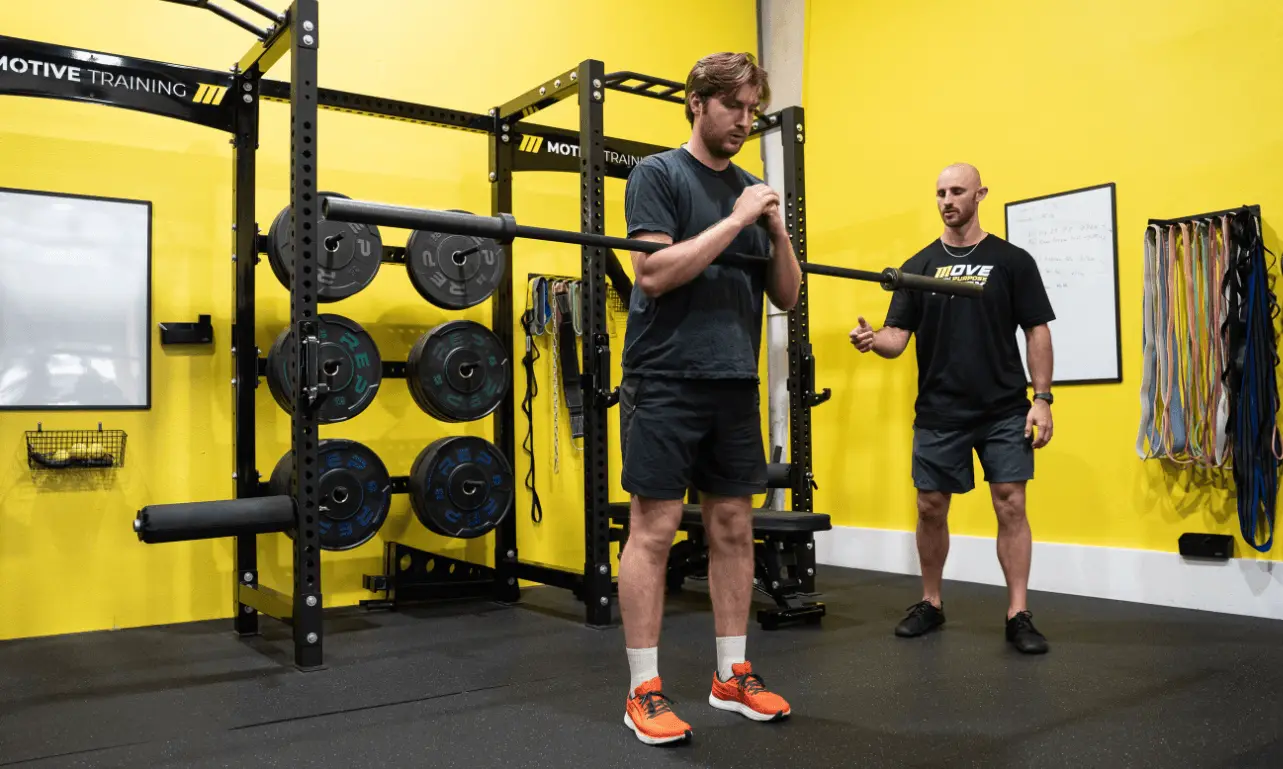
I’ve coached enough busy, driven people to recognize the pattern before they say a word about it. They show up, they push hard, every session gets treated like a test. For a while that works. Conditioning improves fast. The scale moves. There’s a real satisfaction in leaving a session gassed, like the effort itself was the proof of something. Then, somewhere between month three and month eight, the returns start shrinking while the soreness doesn’t. That’s usually the point someone starts asking me a different question. Not how hard should I be training. How should I actually be training.
HIIT does what it’s built to do
Worth saying clearly before picking it apart: HIIT earned its popularity honestly. Short sessions, high effort, a clear finish line. For someone stacking training on top of a demanding job, that structure solves a real problem. You don’t need to plan much. You show up, you go hard for twenty or thirty minutes, and you leave with something that feels like proof of work. Early on, the body responds. Conditioning climbs. Body composition shifts. Confidence follows.
None of that is the part that eventually breaks down. What breaks down is what happens once the body has already adapted to that specific kind of stress and the program has no answer for what comes next except more of the same stress.
Constant intensity has a cost that doesn’t show up right away
Here’s the mechanism, stripped of the marketing language. High-intensity interval work is built around pushing effort close to maximal, repeatedly, in a compressed window. That’s the entire design. It’s effective at building conditioning precisely because it’s demanding. The demand never changes shape, and that’s what eventually causes trouble.
Joints and connective tissue adapt to what they’re consistently asked to do. A program that lives entirely in fast, ballistic, mid-range movement never asks anything of the end ranges, the positions at the edge of a joint’s capacity where strength and control actually protect it under real load. Those ranges don’t get worse from HIIT specifically. They just never get built, while everything else keeps getting pushed harder on top of a foundation that was never addressed. Add in a job that involves long hours at a desk or on a plane, inconsistent sleep, and stress that doesn’t clock out at 6pm, and you’ve got a body absorbing high training stress on top of high life stress with no real deposit going into the account that’s supposed to cover both.
That’s the actual failure point. Not that someone trained hard. That the training never distinguished between effort that builds capacity and effort that just spends it.
Intent isn’t the opposite of intensity
I want to be precise here, because this gets flattened into a false choice a lot. Intent-based training isn’t the soft, low-effort alternative to HIIT. Effort still shows up, often at a high level. What changes is that every session has a specific reason for existing. Some days the target is strength in a position someone couldn’t previously load. Some days it’s joint control, working the ranges that never get touched in a fast circuit. Some days it’s rotational capacity, the trunk’s ability to transfer force through the hips and spine, which almost no interval program trains directly. Effort gets applied to a target instead of applied everywhere at once.
This is the backbone of how we build functional training programs at Motive. A session earns the functional label from what the joints doing the work can actually get into, not from how athletic it looks, and the programming is sequenced so that capacity gets built before it gets loaded hard.
Why this has to start with knowing what you’re actually working with
Guessing which joints or patterns are limiting someone under fatigue is a slow, expensive way to find out. HIIT circuits rarely surface that information cleanly, because fatigue itself hides compensation. Someone can grind through a set with their form quietly falling apart and the workout still counts as completed.
A Functional Range Assessment removes the guessing. We measure what each joint can actually do, actively, before any of it gets buried inside a conditioning circuit. That tells us where the real gaps are and lets programming target them directly, instead of waiting for a shoulder or a low back to announce the problem on its own timeline.
Structure beats novelty, especially for people who already have plenty of chaos
High performers tend to do well with structure. Clear target, clear feedback, clear next step. That’s often what’s missing from a rotating HIIT class, where the variety that makes it fun to attend also makes it hard to track if anything is actually progressing week over week. Effort is high. Direction is vague. Over enough months, that mismatch between how hard someone is working and how much they’re actually building becomes its own kind of frustrating.
We see this a lot with people training around demanding careers, the same crowd that ends up asking what separates a bootcamp-style gym from coaching built around assessment and progression. If that question sounds familiar, this breakdown of what changes with individualized coaching covers the tradeoff directly. The short version is that a rotating class can be a great workout and still not be building toward anything specific, because nobody’s tracking what your joints could and couldn’t do six months ago.
The timing isn’t random, even if the exact age varies
From what I’ve seen, this shift tends to show up once someone’s recovery capacity starts getting squeezed from more directions at once, more travel, less consistent sleep, more years of accumulated training stress on joints that were never specifically addressed. That timeline looks different for everyone, and I wouldn’t put a hard number on it. What’s consistent is the underlying shift. The same intensity stops producing the same return, and people start looking for training that accounts for that instead of ignoring it.
That’s not a step back from performance. If anything, closing the gap between what a joint can be moved into and what it can actually control under load is what lets someone keep training hard without paying for it in setbacks. Strength built on a joint that can support it holds up. Strength built on top of a compensation just makes the compensation heavier.
What actually changes
The aim is putting effort where the body can actually turn it into progress instead of spending it on stress that just accumulates. Intent-based training still asks a lot of someone physically. It just asks for a reason, sequenced against what that person’s body can currently handle, with recovery treated as part of the program instead of an afterthought.
If you’re not sure if your training is building capacity or just spending it, that’s exactly what an assessment is for. Schedule a call and we’ll walk through what we’d look at first.
Written by

Brian Murray, FRA, FRSC
Founder of Motive Training
We’ll teach you how to move with purpose so you can lead a healthy, strong, and pain-free life. Our headquarters are in Austin, TX, but you can work with us online by signing up for KINSTRETCH Online or digging deep into one of our Motive Mobility Blueprints.