Controlled Articular Rotations, commonly called CARs, are one of the foundational practices in modern mobility training. At first glance they look simple. A joint moves slowly through its largest possible circle while the rest of the body stays still. Because the movement looks controlled and deliberate, most people assume CARs are warm-up drills or light mobility work.
They’re not.
CARs maintain joint health, reinforce neurological control of movement, and help you explore the usable range of motion available to each joint. Practiced consistently, they become a daily check-in for the body and one of the most reliable ways to maintain long-term movement capacity.
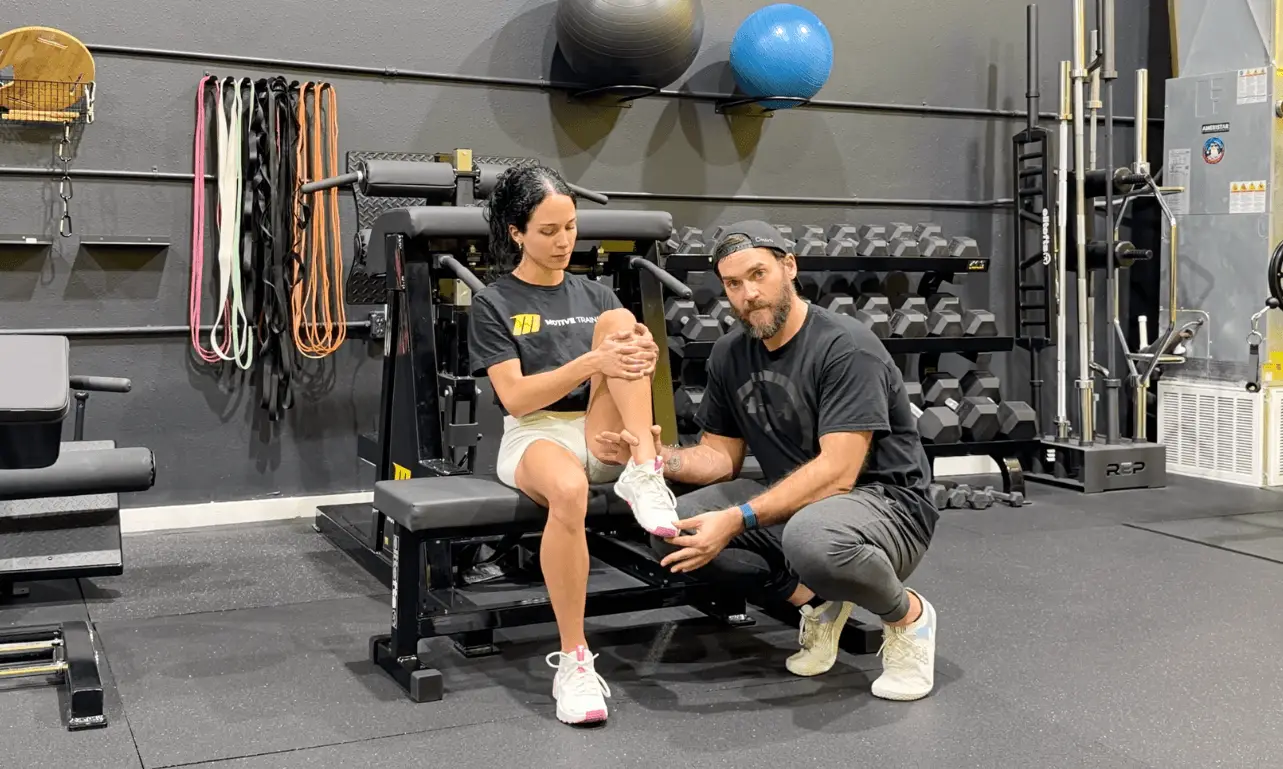
At Motive Training, CARs are a core part of how we approach joint health. They are not filler. They are not something to rush through before the “real” training starts. They are the foundation everything else is built on. Below is a breakdown we filmed showing how we coach ankle CARs and how a small shift in thinking can dramatically change how much you get out of the movement.
What Controlled Articular Rotations Actually Do
Every joint in the body depends on movement to stay healthy. Cartilage relies on motion to receive nutrients, and the fluid inside the joint capsule circulates when the joint moves through different positions. Without regular movement through available ranges, joints gradually lose the capacity they once had.
CARs address this by taking a joint through the largest circle it can actively control. The key word is control. The goal is not to move as far as possible using momentum or compensating with other parts of the body. The movement has to come from the joint being trained while everything else stays quiet.
When performed correctly, CARs reinforce neurological control and help maintain the space and function of the joint. This sits at the heart of Functional Range Conditioning, where joint health and rotational control form the foundation for both mobility and strength.
The Difference Between Moving a Joint and Training One
Most people do ankle CARs and spend the whole time drawing a circle in the air with their foot.
It looks right. It feels productive. But watch closely and you’ll notice the toes curling, the knee drifting, momentum doing most of the work. The ankle itself isn’t doing much.
This is the most common pattern we see across every joint when people first start CARs. The movement looks like the movement, but something else is compensating and completing the circle. The joint you’re trying to train is along for the ride.
A real CAR asks a different question: can you create that rotation slowly, intentionally, and with muscular control through the entire arc?
That’s harder than it sounds, and it’s where most people are leaving progress on the table.
Higher Level Thinking Around Rotation
Once you understand that CARs are about control and not just shape, the next step is thinking about how the joint actually rotates.
Take the ankle. Most people think about ankle CARs as moving the foot up, down, and around. But the ankle and foot work together as a system, and when you start training them that way, the exercise changes completely.
Think of the foot as having two sides. The pinky side and outside ankle work together as one unit. The big toe side and inside ankle work as the other.
As you bring the foot toward the midline into inversion, the goal is to get the big toe side and inside ankle to separate away from each other while the pinky side and outside edge work underneath. You’re rotating the ankle and foot together, not swinging the foot through space.
As you come up toward dorsiflexion you’ll naturally lose some of that rotational capacity. That’s expected. But the intent to rotate stays. You’re still fighting for it.
At the bottom of the circle the relationship reverses. Big toe side comes down, pinky side comes up, inside heel drops, outside heel lifts. Then as you move through the plantarflexed position you hold that rotation all the way to the end.
Slow it way down and feel what’s actually happening. The difference is significant.
Why Control Matters More Than Range
A lot of mobility work focuses on increasing flexibility or achieving larger ranges of motion. CARs take a different approach by emphasizing control of the range that already exists.
When a joint moves through space without control, other parts of the body step in to help. The spine bends, the pelvis shifts, surrounding joints pick up the slack. The circle looks big, but the joint being trained isn’t actually doing the work.
CARs challenge that pattern directly. By creating tension through the body and isolating the joint, the movement becomes far more demanding. The circle may actually get smaller when you do this right, but the quality of the motion improves significantly. Over time that reinforces healthier movement patterns and builds strength in positions that rarely get trained.
CARs as a Daily Joint Health Practice
One of the most valuable things about CARs is how consistently they can be practiced. Daily, ideally. Think of it like brushing your teeth for your joints. Regular exposure to controlled movement helps maintain the health of the joint capsule while keeping the nervous system sharp about where the joint is and what it can do.
CARs also function as an early warning system. Subtle restrictions or asymmetries show up during controlled rotations long before they develop into pain or injury. When you slow down and pay this level of attention consistently, you notice things early. That matters more than most people realize.
If you want to go deeper on ankle mobility specifically, we have a full breakdown inside this ankle mobility foundations class that builds directly on what you see in the video above.
Where CARs Fit Into KINSTRETCH
CARs are not meant to exist on their own. They are the entry point into a larger system.
Once you understand how to actually control a joint through its range, the next step is loading that range and building strength at end positions. That’s where PAILs and RAILs come in. Moving into range is one thing. Owning it is another entirely.
Inside KINSTRETCH Online, we teach the full progression across every joint in the body. Every class is coached with the same level of detail you saw in the ankle breakdown above, not just what to do but why it works and what you should actually be feeling. If this way of thinking about movement is new to you, that’s exactly where to start.
Building Long-Term Mobility
CARs are a reminder that mobility is not a quick fix. It builds gradually through consistent, focused work. Small improvements in joint control accumulate over time and create movement foundations that hold up under real training conditions.
A few minutes of focused joint work each day can preserve movement capacity for years. That consistency is the difference between slowly losing movement options and continuing to build them.
Written by

Brian Murray, FRA, FRSC
Founder of Motive Training
We’ll teach you how to move with purpose so you can lead a healthy, strong, and pain-free life. Our headquarters are in Austin, TX, but you can work with us online by signing up for KINSTRETCH Online or digging deep into one of our Motive Mobility Blueprints.