Austin isn’t short on personal trainers. It has gyms on every corner, box studios multiplying faster than the population, and a wellness industry that never really slows down. So the question worth asking is why so many people still spin their wheels, starting programs, stalling out, getting hurt, and starting over.
The problem usually isn’t effort. It’s the absence of a real system and someone who knows what they’re doing with your specific body. That’s the gap we built Motive Training to fill, and it’s the difference between a workout and a program that actually compounds.
What to actually look for in a personal trainer
The best personal trainers combine credentials, communication, and a clear methodology. Energy and a good playlist aren’t the work. Look for nationally recognized certifications like NASM, ACE, NSCA, or CSCS, specialty credentials in areas like mobility or corrective exercise, and a defined system for how a program is going to evolve over time.
Credentials matter because they set a floor for competence, but they aren’t the whole picture. What matters more than the credential is what comes out when you ask why. A trainer who can explain the reasoning behind every choice, adjust when something isn’t working, and track progress in a way that keeps you moving forward instead of just moving is doing the job. One who can’t probably isn’t. Before you sign anywhere, a few questions are worth asking. Do they screen your movement before building a program, or hand you something generic on day one? Is there a logical progression from session to session, or does every workout feel like it got invented that morning? Do they stay in contact between sessions, or is accountability something you’re expected to manage on your own? And can they tell you clearly what they can help with and when the right move is to send you to a physical therapist or physician?
At Motive, every trainer holds a personal training certification and is also a certified Functional Range Conditioning mobility specialist. That second credential changes how we work. It means programs get designed around the actual capacity of your joints and nervous system, not just the muscles you’d see in a mirror.
Why most people fall short of their goals
Most people who fall short of their fitness goals are perfectly motivated. What they’re missing is the structure that makes consistency survivable when life gets hard, the program calibrated to their actual body, or someone holding them accountable when willpower has the bad day it always eventually has. We’ve seen the pattern often enough to recognize the shape of it. Someone gets motivated by a new year, a number on the scale, a doctor’s visit, or a birthday that ends in zero. They start hard. Two months later, something breaks down, an injury, a schedule change, a plateau, and they’re back to square one.
The missing piece is rarely more willpower. It’s a system built to survive real life. A program calibrated to your body, a trainer who stays engaged between sessions, and a community that gives you something to show up for even when you’d rather not. That structure is built into how Motive works, including through our custom mobile app, which keeps you connected to your coach and your fellow clients when you’re not in the gym.
A knowledgeable, credentialed trainer provides more than just a workout — he or she offers a quality educational experience, helping you to separate fitness fact from fiction and empowering you to make meaningful changes and positive choices as it relates to your overall wellness.
— Brian Cassady, Manager of Motive Training
What sets Motive apart from other Austin personal trainers
Austin has plenty of solid trainers. What it largely doesn’t have is trainers who understand joint mechanics, neurological control, and the relationship between mobility and durability at a clinical level, and who can build all of that into a personal training program from day one. That’s the gap our work fits into.
We assess before we build
The first thing we do is look at how you actually move. Every personal training relationship at Motive starts with the Motive Movement & Mobility Assessment, a joint-by-joint movement screen that tells us where your restrictions are, where you’re compensating, and which gaps in your active range of motion are quietly building toward an injury. Most trainers skip this entirely. Writing a program without it is like giving someone directions without knowing where they’re starting from.
Mobility as a core training variable
The standard approach to mobility in the industry is five minutes of stretching tacked onto the end of a session. We treat it as a foundational training variable, weaving controlled articular rotations, PAILs, and RAILs into the actual session alongside conventional strength work. The point is to build strength within your ranges of motion rather than just up to the edge of them, because passive flexibility without active control is exactly where injuries happen. That space between passive and active range is what Dr. Andreo Spina, who developed Functional Range Conditioning, calls the injury gap. Closing it is most of what we do.
We stay engaged between sessions
What happens between sessions matters as much as what happens in them. Our custom app keeps your programming in your pocket, your coach available when you have questions, and the Motive community visible so you remember you’re not doing this alone. Most clients tell us it’s one of the things they didn’t know they needed until they had it.
Who actually trains at Motive
Motive Training works well for adults who want more than a generic workout, who care about moving better, building durable strength, reducing pain, and staying active for decades. Several patterns of clients show up regularly.
The first is Austin’s tech workforce. If you’re sitting eight or more hours a day at Dell, Apple, Tesla, Google, or any of the other major employers that have made Austin one of the fastest-growing tech cities in the country, your body is accumulating a specific kind of damage. Hip flexors shorten. Thoracic mobility deteriorates. Neck and shoulder pain becomes the background noise of your life. We’ve built programs specifically for this pattern, and we know how to reverse it. The longer treatment of what sitting actually does to the body sits on its own page.
The second is recreational athletes. Pickleball players, cyclists on the Veloway at Circle C, runners training for the Austin Marathon, CrossFitters near St. Elmo, they all need programming that supports their sport and keeps them out of the injury cycle. FRC-based training is particularly good at this because it builds the joint capacity that high-output activities demand but rarely develop on their own.
The third is people with a history of injury. Chronic back pain, a knee that never quite came back, a shoulder that’s been “manageable” for two years, these are cases where our FRC background makes a real difference. We understand the connection between joint health, range of motion, and pain in a way a standard personal training background doesn’t always cover. We also know when to refer out, and we have strong relationships with Austin’s physical therapy community for exactly those moments.
The fourth is people who’ve tried and quit before. If you’ve started and stopped more programs than you can count, the problem almost certainly comes down to the absence of a structure that holds up across real life. That’s what we’re here to fix.
What Functional Range Conditioning actually is
Functional Range Conditioning is a joint health and mobility training system developed by Dr. Andreo Spina, who is both a chiropractor and a kinesiologist. It uses controlled movement and progressive isometric loading to build strength, neurological control, and usable range of motion at every joint from the ankle to the cervical spine. Professional sports organizations, physical therapists, and NASA’s Human Health and Performance team use it.
The core insight is that passive range of motion, how far a joint can go when something else moves it, isn’t the same thing as active, usable range of motion. Studies suggest we have ten to fifteen degrees more passive range than the nervous system will allow us to access actively. Don’t quote me on the exact number, the methodology varies, but the pattern is solid. Static stretching may temporarily push that boundary, but because no muscular control is built at the new range, the gains are short-lived. FRC trains both the range and the control at the same time, which is what makes the gains stick.
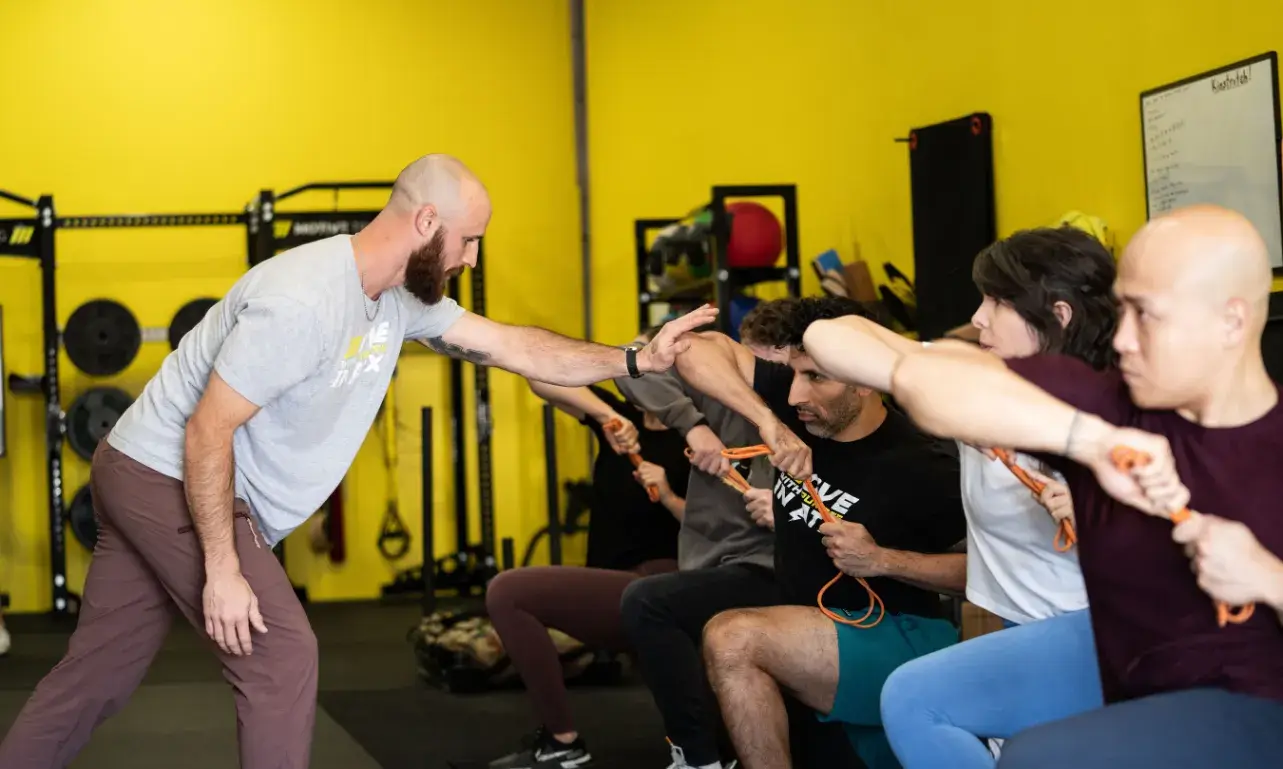
The main tools are controlled articular rotations, which are slow, deliberate joint circles used daily for maintenance and assessment, and PAILs and RAILs, which use progressive isometric loading at end-range positions to convert passive flexibility into active, owned mobility. KINSTRETCH is the group class format that puts these principles into a coached, structured session. If you haven’t tried it, it’s harder than it sounds and more effective than almost anything else you’ll find in Austin for joint health.
How getting started works
The first step is a conversation and a movement assessment, not a sales pitch. A good trainer should look at how you move, ask the right questions, and tell you honestly what they think before you commit to anything.
Our process is straightforward. You reach out. We set up a time to talk and run you through the initial Motive Movement & Mobility Assessment. From there, we build a program around your goals, your schedule, and what we found in the assessment, not a template pulled from a file. You train, we track progress together through the app, and we adjust as things evolve.
A few practical things people commonly ask before getting in touch. Personal training rates in Austin generally run from about $60 to $150-plus per session depending on credentials, experience, and format. We offer both individual and semi-private options, and we’d rather talk through what makes sense for your goals than have you work off a number on a page. Two to three sessions a week is the sweet spot for most people, enough frequency to build momentum with enough recovery in between, though plenty of our clients train with us once or twice a week and use the app to stay on track between sessions. You don’t need to be in shape before starting. The assessment meets you exactly where you are, sedentary, moderately active, or already training and trying to stop getting hurt. We’re at 714 Shelby Lane in South Austin near the St. Elmo Arts District, with online training and remote coaching available for clients throughout Texas.
If you’re ready to find out what this actually looks like for you, let’s talk.
Written by

Brian Murray, FRA, FRSC
Founder of Motive Training
We’ll teach you how to move with purpose so you can lead a healthy, strong, and pain-free life. Our headquarters are in Austin, TX, but you can work with us online by signing up for KINSTRETCH Online or digging deep into one of our Motive Mobility Blueprints.