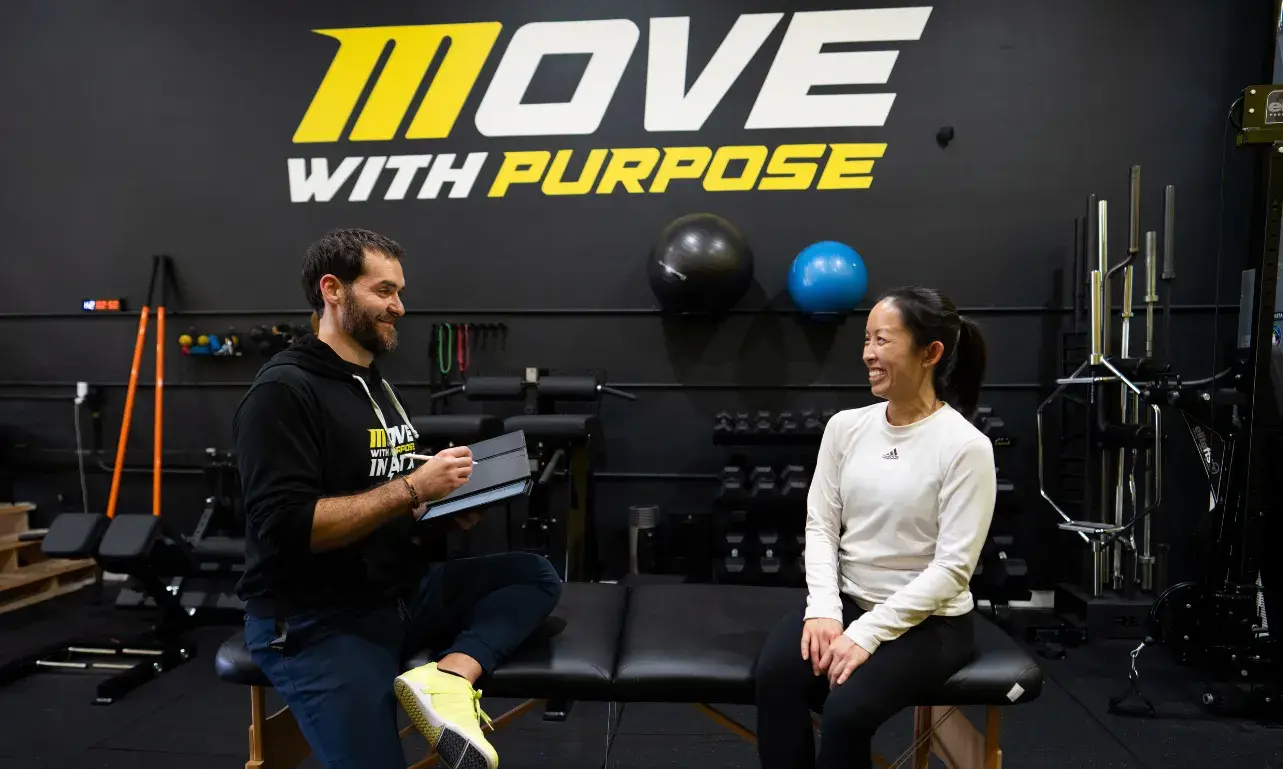
Should you hire a personal trainer
When someone finds out I’m a personal trainer, the reaction is pretty predictable. They picture celebrity workouts, or someone screaming at a client on a treadmill, or an influencer filming their own sessions in a mirror. That version of personal training exists. It’s also a poor representation of what the work actually is.
The question most people are really asking is simpler: is it worth the money.
That’s a fair question, and the honest answer is that it depends almost entirely on the quality of the trainer. A bad trainer with a bad process isn’t worth anything. A good trainer who coaches with intent and builds a plan around how your body actually moves is one of the better investments you can make in your physical health. The gap between those two things is wider than most people realize before they’ve experienced both.
What good personal training actually is
The workout is the visible part. The session, the exercises, the sets and reps; that’s what people think they’re buying.
What you’re actually paying for is the decision-making around the training. A good trainer is constantly evaluating what’s limiting your progress, what capacity is missing, what should be prioritized, and what can wait. That evaluation doesn’t stop when the session ends; it continues across weeks and months as the data accumulates.
Most people who plateau aren’t failing because they’re not working hard enough. They’re failing because the training lacks direction. The wrong things are being trained, or the right things are being trained in the wrong order, or there’s a physical bottleneck that nobody has identified because nobody looked.
A good trainer removes that guesswork. Not by having all the answers upfront, but by having a process that surfaces the right questions.
Assessment is where good training starts
If a trainer skips assessment, they’re guessing about your body from minute one. That’s worth saying clearly.
Assessment doesn’t need to be complicated, but it needs to establish objective baselines. At Motive, we use a joint-by-joint evaluation as the foundation of every new client relationship. We want to know what’s limited, what’s controllable under your own power, and what the gap is between the two. That gap (the difference between passive range and active range) is where most of the useful information lives.
The Motive Movement and Mobility Assessment is where we start. For clients who have a specific limitation that warrants a deeper look, the Functional Range Assessment goes further. Either way, the point is the same: you can’t build an intelligent program without knowing what you’re working with.
Most people have never had this done. They’ve had personal training, but not assessment-led personal training. The difference shows up fast.
The difference between coaching and supervision
You should feel coached, not watched.
A trainer who counts your reps and says “good job” is providing supervision. That has some value: accountability, structure, a reason to show up. But it’s not coaching. Coaching means you’re being watched closely enough that someone can catch the thing you can’t feel: the compensation pattern you’ve been using for so long it feels normal, the range limitation that’s been shifting load to the wrong place, the way your body is protecting something without you realizing it.
Good coaching also means you understand what you’re building toward. Not just “get stronger” or “lose weight,” but the specific capacities that are currently limiting you and the specific reasons they matter. That understanding is what lets you eventually train intelligently on your own, which is what good coaching should eventually produce.
What to look for when you’re evaluating a trainer
A few questions that tell you more than a certification list:
How do you assess new clients, and what does that assessment inform? If the answer is vague or the assessment sounds like a fitness screen disconnected from program design, that’s a signal.
How do you handle pain or flare-ups? Trainers who work around pain indefinitely without trying to understand it are delaying the same problem. Trainers who stop everything the moment discomfort appears are being overcautious in a way that limits progress. The right answer involves some version of identifying what’s driving it and addressing capacity.
How do you measure progress beyond bodyweight and performance metrics? Strength going up while joint function degrades isn’t progress. A trainer who only tracks output and ignores how the body is holding up is missing half the picture.
If the answers to those questions are clear and specific, the trainer has a real process. If they’re generic, the plan will be too.
Who tends to benefit most
People who are dealing with recurring pain see some of the biggest returns from working with the right trainer. When something keeps flaring up despite changing workouts or taking time off, the missing piece is usually capacity at the joint level; not tissue damage, not something that needs more rest, but a range you don’t own and a position your body can’t load safely. Functional Range Conditioning gives us a framework for addressing exactly that. The work is specific enough to actually change something.
People who want to get stronger without losing mobility also tend to thrive with a coach. Strength training narrows options when it’s done without attention to joint health. Done well, it expands them. A trainer who understands the difference can build programs that do both simultaneously rather than treating them as separate goals that compete.
And people who’ve been training consistently without meaningful results almost always benefit. Effort isn’t the variable. Direction is.
In-person versus remote
In-person training is harder to replicate than the fitness industry likes to admit. Real-time feedback on how you’re moving, adjustments to load and position mid-set, the ability to actually see compensation as it’s happening; these things matter, especially early in the process when movement patterns are still being established.
Remote coaching can work well for the right person with the right coach. Where it tends to fall apart is when it becomes a generic program sent monthly with minimal review. The value of remote coaching is in the structure and the ongoing relationship, not the program document itself.
If your primary goal is improving joint control and you want something you can do at home, KINSTRETCH Online is a structured option built on the same FRC principles we use in person. It’s not a replacement for individual coaching, but it’s a real starting point for people who aren’t ready to commit to one-on-one work or who want a complement to their existing training.
The honest answer to the question
Hiring a personal trainer is worth it when you’re hiring someone who coaches with intent, builds a plan around your actual body, and helps you make decisions you can’t make alone.
It’s not worth it when you’re paying for supervision without strategy.
Those two things can cost the same and look similar from the outside. The difference is in the process: assessment, technical coaching, a plan that evolves, and progress measured against something meaningful. That’s what training is supposed to be. If you’re getting that, it’s worth it. If you’re not, you’re paying for company.
If you’re in Austin and want to see what this looks like in practice, reach out.
Written by

Brian Murray, FRA, FRSC
Founder of Motive Training
We’ll teach you how to move with purpose so you can lead a healthy, strong, and pain-free life. Our headquarters are in Austin, TX, but you can work with us online by signing up for KINSTRETCH Online or digging deep into one of our Motive Mobility Blueprints.