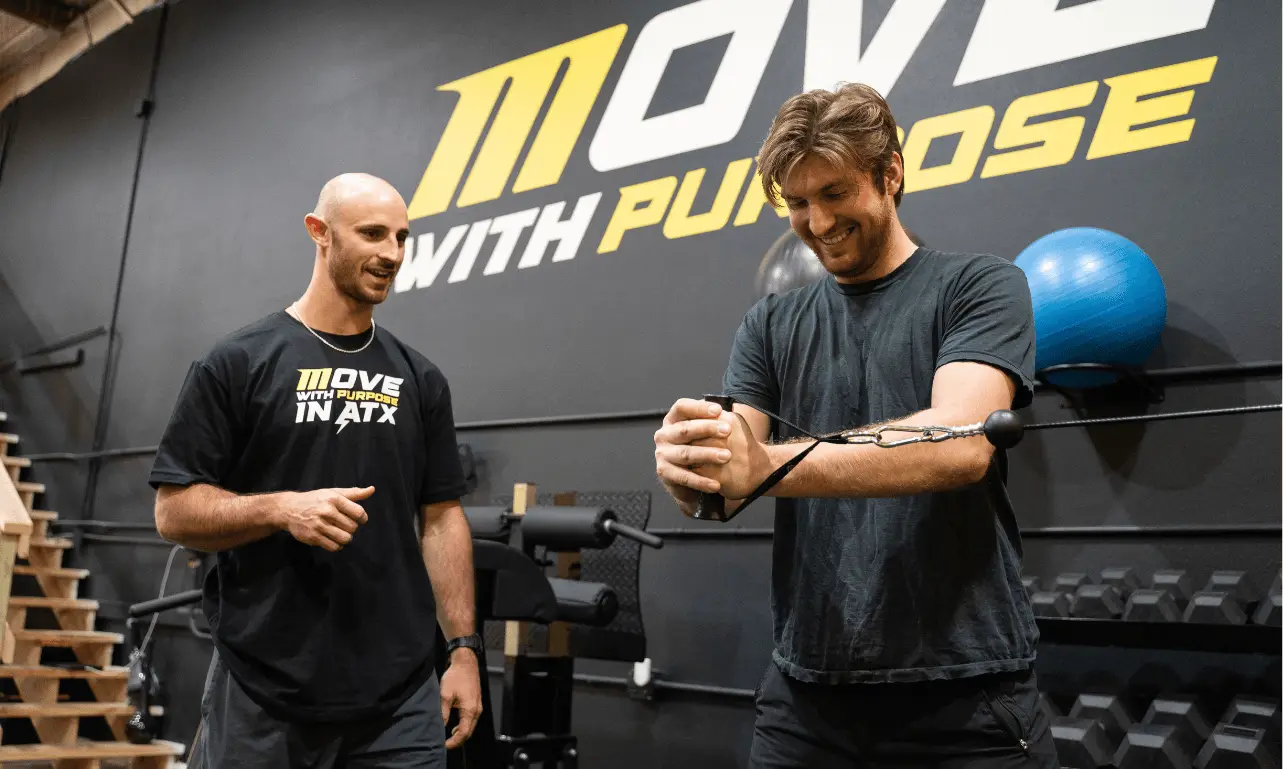
People searching “personal trainer cost” want a number. Something clean, like seventy five dollars an hour, so they can compare it to a gym membership and decide. The problem is the number by itself tells you almost nothing, because two trainers charging the same rate can be selling completely different things. One is running you through a circuit off a template. The other spent a year and two thousand dollars in FRC certification before they ever touched your first session. Same number on the invoice. Not close to the same thing.
The useful question is what’s actually built into that price, because that’s the part that determines if the training works.
Why the number varies so much in the first place
A trainer’s rate has to cover more than the hour you’re standing in front of them. It covers the time they spend planning your program between sessions, the education they’ve paid for out of pocket to be able to assess and coach at a certain level, and the simple math of how many people they can train one on one in a week before burning out. A coach running true one on one sessions is capped on volume in a way a group class instructor isn’t. That cap is priced in.
Credentialing is a real, specific cost, not a marketing line. FRC certification runs close to a thousand dollars. KINSTRETCH certification is another thousand plus a monthly licensing fee just to keep teaching it. None of that shows up on your invoice as a line item, but it’s baked into the rate of anyone who actually went and got it, the same way a contractor’s rate reflects their tools and their years of learning what not to do. A trainer who skipped that route can legitimately charge less. They’re also working from a smaller toolkit.
Market matters too. Austin has everything from twenty five dollar big box sessions to boutique studios charging several times that, and the spread isn’t random. It tracks pretty closely with how much assessment, attention, and actual expertise sits behind the number.
The part that determines if the price was worth it
Most gyms will get you moving in your first fifteen minutes off a questionnaire. That’s fast, and it’s also a guess, because nobody yet knows how your hips actually move or where your real restrictions are hiding. At Motive, new personal training clients start with a Motive Movement and Mobility Assessment, a focused look at the joints and positions tied to whatever’s actually bringing you in. That’s a different thing than a longer intake form, because the program that comes out of it is built on what your body is actually telling us, not on what worked for the last client who walked in.
That distinction is where the price either earns itself back or doesn’t. A cheaper session that skips this step isn’t really a discount. It’s a different, less informed product being sold at a lower price, and the real cost shows up later, in the plateau, the flare up, or the six months spent doing a program that was never built for the body doing it.
What you’re actually funding session to session
Strip away the marketing language and a good trainer’s rate is funding three things. Programming built around your specific limitations rather than a template someone else already wrote. Coaching in the room, meaning someone watching your positions in real time and correcting them before a bad pattern gets reinforced, not just calling out reps. And the accountability structure that gets people through the weeks where motivation alone wouldn’t be enough. That third one gets dismissed as soft, but it’s usually the actual difference between someone who trains consistently for a year and someone who quits in March.
None of that requires inventing a client story to prove the point. Anyone who’s trained people long enough has seen the same pattern often enough that it doesn’t need embellishing: the clients who stick with a program built around their actual restrictions get further than the ones grinding through something generic, and it isn’t close.
Where this fits against the rest of the market
If you’re comparing a private studio against a big box gym specifically, that’s a deeper comparison than cost alone, and we’ve written about it separately in more detail. The short version here: a private studio’s higher rate is usually buying you undivided attention and a coach who isn’t managing ten people on the floor at once. That trade is worth it or it isn’t depending on what you’re actually training for and how much you need eyes on your form.
A few direct answers
How much should I expect to pay for a personal trainer
There’s no single number that holds up across markets. What you should ask instead is what’s included: is there an actual movement assessment before programming starts, is the coach certified beyond a weekend course, and are sessions truly one on one or split across several clients at once. Those answers matter more than the rate itself.
Is a cheaper trainer automatically a worse choice
Not automatically, but cheap and undifferentiated usually travel together. A lower rate is fine if it’s honestly reflecting a simpler service. It’s a problem when it’s marketed as the same thing a more expensive, assessment driven program offers.
Do I need a full assessment before starting personal training
At Motive, yes, in the form of the Motive Movement and Mobility Assessment. Rather than a hurdle before the real training starts, it’s the information the real training gets built on.
Is personal training worth it if I’ve never had an injury
Assessment based coaching isn’t only for people already in pain. It’s also how you catch a restriction before it turns into one, which is usually cheaper in every sense than fixing it after the fact.
Where to start
If you want to see what an assessment driven approach actually looks like, the Functional Range Assessment page walks through both the faster entry point and the deeper joint by joint version, and you can decide which fits what you’re dealing with. From there, personal training at Motive is built around whatever that assessment turns up, not a template we hand to everyone who walks in. If you’re not in Austin or not ready for in person coaching yet, Motive Mobility gives you the same coaching lens from wherever you are.
Written by

Brian Murray, FRA, FRSC
Founder of Motive Training
We’ll teach you how to move with purpose so you can lead a healthy, strong, and pain-free life. Our headquarters are in Austin, TX, but you can work with us online by signing up for KINSTRETCH Online or digging deep into one of our Motive Mobility Blueprints.