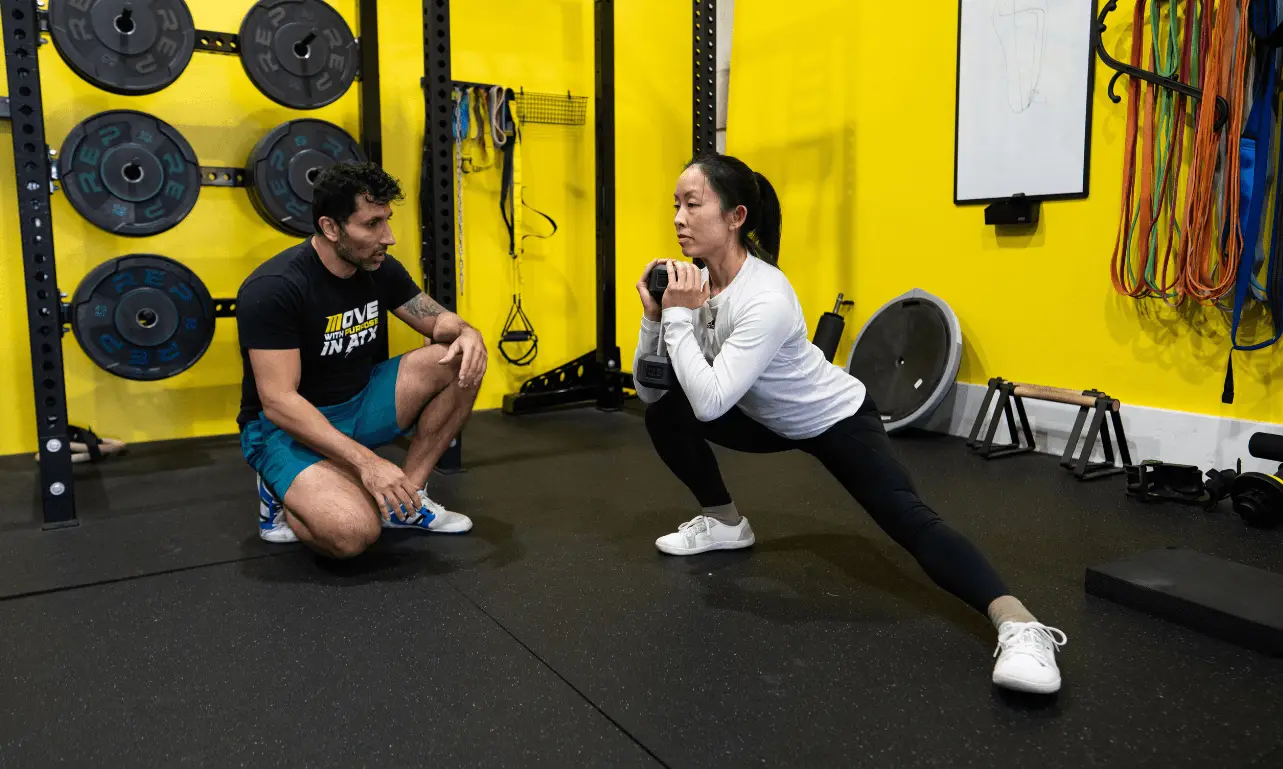
“Affordable personal training” can mean a lot of things.
Sometimes it means “cheap.” Most of the time, it means “I want help, but I don’t want to waste money guessing.”
That’s a fair ask.
In Austin, you can find trainers at big-box gyms, boutique studios, group-class concepts, and everything in between. The hard part is not finding someone. The hard part is knowing who can actually coach you, build a plan that fits your body, and keep you progressing without constantly dealing with setbacks.
This guide is how to think about affordability the right way, and how we approach it at Motive Training in South Austin.
What personal training actually is
Personal training is not someone counting reps.
Good personal training is coaching plus problem solving.
You should be getting:
- A plan that matches your goals and your current capacity.
- Coaching that improves execution, not just effort.
- Progression that is intentional, not random.
- Adjustments based on what your body is doing that week.
- Accountability that supports consistency without burning you out.
If you leave every session tired but you are not building anything measurable, it stops being training and turns into paid exercise.
The real meaning of affordable personal training in Austin
Affordable usually gets framed as “price per session.”
That’s only one piece of the math.
A more useful definition is: the best return on time, money, and energy.
Here are three ways personal training becomes more affordable, even if the hourly rate is not the lowest option in town.
You stop wasting weeks on the wrong focus
A lot of people train hard and still feel stuck because the limiter is not effort.
It’s a missing ingredient: joint range of motion you can control, a strength pattern you cannot own, an old injury that keeps getting poked, or a program that does not match your recovery.
When your training starts with clarity, you stop spending money on guesswork.
If you want to see how we build that clarity, start here: Functional Range Assessment.
You use coaching to reduce trial and error
Most “expensive” training mistakes are not dramatic injuries.
They’re the slow leaks:
- The shoulder that gets cranky every time pressing volume goes up.
- The low back that tightens after leg day.
- The hip that never feels stable in single-leg work.
- The knee that tolerates running, until it doesn’t.
A coach should catch those patterns early, adjust inputs, and keep you moving forward.
If pain has been part of your training loop, this page lays out our approach: pain-relief personal training in Austin.
You pick the right model for your schedule
For some people, one-on-one training is the best fit. For others, a hybrid approach works better: fewer in-person sessions plus a clear plan to run on your own.
If your goal is affordability and consistency, you should ask a trainer what options exist, and how they build a plan around them.
What you should expect from a good trainer
Here’s the baseline.
If a trainer cannot do these things, it does not matter how “motivating” they are.
They assess something real
Not a vibe check. Not a “movement screen” that ends with generic stretches.
You want measurable information that guides decisions.
At Motive, that baseline is FRC. If you want the deeper explanation of the system, read: Functional Range Conditioning.
They can explain the “why” in normal language
You should understand:
- What you are working on right now.
- Why it matters for your goal.
- How you will progress it over time.
- What success looks like in the next 4-8 weeks.
If everything sounds like mystery and magic, it usually is.
They track progress beyond the scale
Progress can be a lot of things:
- Range of motion you can actually control.
- Strength numbers that trend up without pain.
- Better positions under load.
- More energy, better recovery, fewer flare-ups.
If none of that is being tracked, you are paying for workouts, not coaching.
Our approach at Motive Training in South Austin
We built Motive around one simple belief.
Your training should match how your body actually moves.
That starts with assessment and it continues with programming that builds capacity, not just fatigue.
Assessment first, then training
For most clients, the first step is understanding what is limited and what is controllable.
That’s why we use the Functional Range Assessment. It gives us joint-by-joint information that actually matters for training decisions.
If you want the long-form breakdown of how FRA works, this is a good read: Functional Range Assessment guide.
Strength and mobility are trained together
We do not separate “mobility day” from “real training.”
We build range, then we strengthen it, then we express it under load.
That can look like:
- Expanding hip and ankle options so your squat stops borrowing from your low back.
- Building shoulder rotation so pressing stops turning into compensation.
- Training trunk control so your ribs, pelvis, and spine stop fighting each other.
The details change based on the person, but the principle stays the same.
Coaching is the product
The exercise menu is not special. The decisions are.
Most people do not need more variety. They need better sequencing, better constraints, and better feedback.
That’s what coaching is.
If you want a more affordable way to start, take a class
If you are interested in improving mobility, reducing stiffness, and building joint control without jumping straight into one-on-one training, classes can be a smart entry point.
Our mobility system is KINSTRETCH.
You can train in-person here: KINSTRETCH in Austin.
Or train at home with structured sessions: KINSTRETCH Online.
Both options are built around the same idea: usable range of motion, end-range strength, and better control.
How to choose the right personal trainer in Austin
If you are comparing gyms or coaches, use this checklist.
Ask how they assess and how that changes the plan
If their answer is “we just start training and adjust,” that is not a system.
You want to hear what they measure, what they look for, and how they decide priorities.
Ask what progress looks like in the first month
A good coach should be able to tell you what they expect to improve first.
It might be strength. It might be range. It might be pain reduction. It might be consistency.
If they cannot define it, it will not be coached.
Ask how they program for the days you are not with them
Even if you train one-on-one, most of your week happens outside the session.
If there is no plan beyond the hour you paid for, affordability disappears fast.
Ask how they handle pain and limitations
You are not hiring someone to ignore your limitations.
You are hiring someone to respect them, assess them, and build around them so they change.
If you want an affordable personal trainer in Austin, start with clarity
Affordable training is not the cheapest session.
It’s the training that helps you stop guessing, stay consistent, and build progress you can feel and measure.
If you want one-on-one coaching in South Austin with an assessment-led approach, start here: South Austin Personal Trainer.
Written by

Brian Murray, FRA, FRSC
Founder of Motive Training
We’ll teach you how to move with purpose so you can lead a healthy, strong, and pain-free life. Our headquarters are in Austin, TX, but you can work with us online by signing up for KINSTRETCH Online or digging deep into one of our Motive Mobility Blueprints.