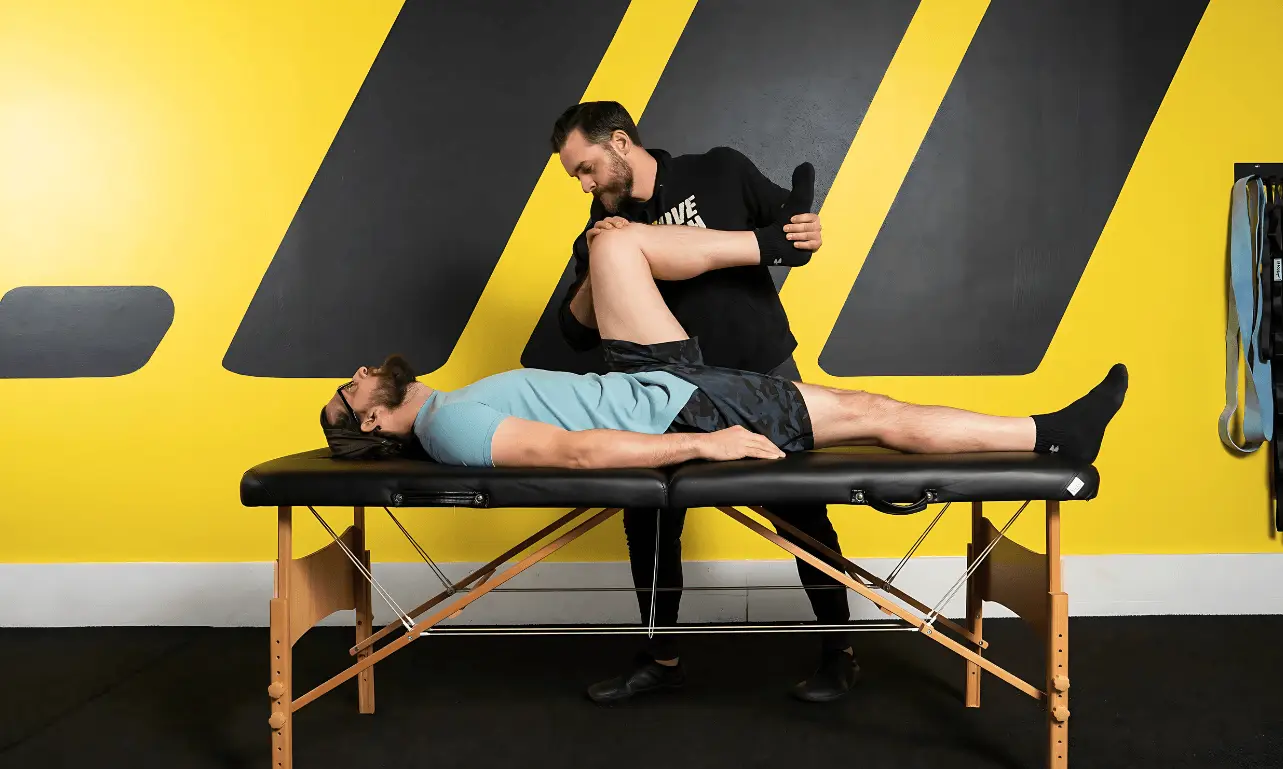
The most useful number in joint training is not how flexible you are. It is the difference between how flexible you are and how much of that flexibility you can actually use. That number is the active-passive gap, and almost no standard assessment in fitness measures it directly. The Functional Range Assessment is built around it. Once you understand what the gap is and what it costs you, the rest of how we train at Motive Training starts to make more sense.
This is the long form on what the FRA actually does, what it measures, why we use it as the starting point for almost every program, and what to expect if you book one. It is meant for people who have either been bounced between modalities without much progress or who have done plenty of fitness and finally want to know what is going on at the joint level. If you want the short version, the FRA is a joint-by-joint movement assessment that gives us objective measurements for passive range, active range, and the gap between them, and we use those measurements to write your training instead of guessing.
What the FRA measures
The FRA looks at one joint at a time. Each major articulation from the cervical spine down to the toes gets tested through its specific motions. For the hip, that means flexion, extension, internal rotation, external rotation, abduction, adduction. For the shoulder, the same logic across its motions. We do this in two ways for each motion.
First, passive range. We move the joint for you. You relax and let the motion happen. The number we get is the available range when nothing is asking the muscles to control it. This is the ceiling. It is the most range your soft tissue, capsule, and joint surfaces are giving you on that day.
Second, active range. You move the joint yourself, against gravity and without help, holding the end position for a count. The number we get is the range you can produce and own under your own control. This is your usable range.
The gap between those two numbers is the most important data point in the assessment. If you can be moved into 90 degrees of hip internal rotation passively but only generate 45 degrees actively, that 45-degree gap is range you technically have but cannot control. Range you cannot control is range your nervous system does not trust, which usually means it is not range your body lets you use during sport, lifting, or daily life. We call it borrowed range. It looks like flexibility, but it does not function like it.
The reason this matters is mechanical. The brain has protective braking on your active range, holding you about 10 to 15 degrees short of where your passive range ends. This is a feature, not a bug; it keeps you out of positions you cannot stabilize. But the size of that brake is not fixed. It can shrink with training that builds control at end range. Or it can grow with disuse, pain, or compensation patterns, until you have a lot of passive range and almost none you can actually use.
Why the gap matters more than flexibility
Most people get evaluated on flexibility alone. Can you touch your toes. How far does your shoulder go overhead. Where does your knee come up to in a hip flexion test. These are all passive-range questions, and they are not wrong, but they are incomplete. Two people with the same passive numbers can have very different functional outcomes, and the difference is usually the gap.
The person with a small gap has range they can use. They can produce force at end range, decelerate at end range, and tolerate load near the edges of their motion. The person with a large gap has range they can sit in but not own. When sport, life, or load pushes them into those edges, the body has no available control. That is the position where most non-contact injuries happen. It is also the position where compensations get borrowed from adjacent joints, which is how a hip mobility problem becomes a low back issue, and a thoracic problem becomes a neck issue.
If you have read our piece on mobility versus flexibility, this is the underlying mechanic. Mobility is range you can control. Flexibility is range you have. The gap is the difference. The FRA measures all three.
What the FRA is not
It is not a medical diagnosis. We do not tell you what your pain is. We tell you what your joints are doing. That distinction matters, especially in Texas where personal trainers cannot legally diagnose, and especially because pain and movement are related but not identical. People come in with painful joints that test fine, and joints that test poorly with no pain at all. The FRA tells us about capacity and control. It does not tell us about pathology.
It is not a movement screen. Tools like the Functional Movement Screen ask you to perform multi-joint patterns and grade the result. That can be useful, but it tells you that something is off without telling you which joint is responsible. If a deep squat looks bad, is it the ankles, the hips, the thoracic spine, the neuromuscular control, or some combination. A screen says the pattern is poor. The FRA tells you, joint by joint, what each contributor is bringing to the pattern. That is the difference between a verdict and a chart.
It is not a stretching prescription. The training plan that comes out of the FRA usually involves a lot less passive stretching than people expect. Stretching can raise the ceiling, but it does not close the gap. Closing the gap requires loading at end range, which is most of what we end up doing.
What we do with the data
The data is only useful if it changes what we have you do. Here is roughly how we read the results.
If the gap is large on a joint that matters for your goals, that joint moves to the top of the priority list. The training for it is end-range isometric work, specifically variations of PAILs and RAILs, to teach the nervous system to produce force at the new positions. The technique is uncomfortable but specific. Two minutes of well-cued PAILs at end range will do more for the gap than thirty minutes of passive holding.
If the passive range itself is limited, we work on raising the ceiling first. Capsular work, structured stretching with intensity, and joint-specific drills come in here. The ceiling has to be available before we worry about how much of it you can use.
If both passive and active are limited, we usually find a soft tissue or capsular constraint that needs to be addressed first, then we build control inside that new space. This is the slowest pattern to change, but the changes hold once they happen.
If the numbers look good and the complaint is still real, we widen the search. Sometimes the problem is not the joint we were looking at but the one above or below it. Sometimes it is loading exposure, not capacity. The FRA gives us enough information to rule things out, which is often more useful than ruling things in.
Across all of this, the daily maintenance piece is Controlled Articular Rotations. CARs are how we keep the work from regressing between sessions, and they double as a daily check-in on what your joints are doing.
How the FRA fits into a training plan
The assessment is not the program. It is the input that lets us write the program. After your FRA, you will leave with a clear sense of which joints are limiting you, where the gaps are biggest, and what the first six to twelve weeks of training should target. From there, the path usually goes one of three ways.
Some people fold the work into ongoing personal training, using the FRA priorities as the mobility component while we build the rest of the strength and conditioning around it. Some people use KINSTRETCH classes as the primary training input, since the class structure cycles through every major joint over a few weeks and gives you supervised end-range work in a group setting. Some people, especially if they are not local, take the priorities home and train through KINSTRETCH Online on their own schedule.
The reassessment is part of the system. Every twelve weeks or so we retest the limiting joints, and the numbers tell us what the work is moving: the gap, the ceiling, or both. If the numbers are not moving, the program changes. This is the part most fitness models do not have, an objective check on what the training is actually doing.
Who should book one
There is a useful filter. The FRA is worth it for you if any of the following are true. You have recurring pain or stiffness that has not responded to general fitness or generic mobility work. You have done plenty of strength training and have a sense that your joints are the limiting factor more than your muscles. You are returning from an injury and want to know objectively where you are. You play a sport or do an activity that demands a specific quality, such as rotation, overhead capacity, or deep hip flexion, and you want to know what you actually have at that joint. You are a beginner who wants a smarter starting point than guessing.
It is less useful if you are looking for an injury diagnosis, in which case a physical therapist or physician is the right call, or if you are looking for a quick fix. The FRA gives you a map. The map is only useful if you train off it for the next several months.
Frequently asked questions
How long does a Functional Range Assessment take?
About two hours. We test the major joints relevant to your goals and complaints, document the numbers, and walk you through what they mean. The session ends with a clear set of priorities and a recommended next step.
Do I need to be fit or flexible to do an FRA?
No. The assessment measures where you are now. People come in with significant restrictions and almost no training history, and they come in as competitive athletes with specific deficits they want to identify. The numbers tell us what to do regardless of starting point.
How is the FRA different from a movement screen like the FMS?
A movement screen looks at multi-joint patterns and tells you the pattern is good or compromised. The FRA isolates each joint and measures passive range, active range, and the gap. The screen gives you a verdict on the pattern. The FRA gives you the contributors. You can use both, but the FRA is more useful for writing a training program because it tells you specifically which joint to target.
Will the FRA fix my pain?
Not directly. The FRA is not a treatment, and we do not diagnose. What it does is identify the mechanical limitations and control problems that often show up alongside pain. Addressing those through training reduces the conditions that produce the symptoms, but the path is slower and more honest than a pain protocol that promises a fix.
How often should I get reassessed?
Every twelve weeks for an active training block is a reasonable cadence. If the training is targeted at specific gaps, twelve weeks is enough time for meaningful change in passive range, active range, or both, and the retest tells us what to do next: continue, progress, or change direction.
Can I do anything before booking an FRA?
Daily CARs are a reasonable starting point and cost nothing. They will not give you the assessment data, but they will start to build joint workspace and give you a sense of where your body feels limited. That awareness usually makes the assessment itself more productive.
A note on what this changes
The reason we built our process around the FRA is that the biggest waste in training is doing the right work on the wrong joint. People spend years working on hip mobility when the limitation is actually thoracic. They work on shoulder mobility when the limitation is the rib cage. They train through pain that is not coming from where they think it is coming from. The FRA does not eliminate that problem, but it puts a real number on it and makes the next decision much easier.
If you have been bouncing between approaches and want a clear starting point, book a Functional Range Assessment and we will give you the map. From there, the training is your decision, and so is the pace. Our job is to make sure the work you do is the work that actually moves the gap.
Written by

Brian Murray, FRA, FRSC
Founder of Motive Training
We’ll teach you how to move with purpose so you can lead a healthy, strong, and pain-free life. Our headquarters are in Austin, TX, but you can work with us online by signing up for KINSTRETCH Online or digging deep into one of our Motive Mobility Blueprints.