I have been a personal trainer for seventeen years, and for most of that time I taught mobility the way the industry taught it. Stretch the tight thing, foam roll the angry thing, hold the position long enough for it to feel like something happened. It worked, sort of. People felt looser for a few hours. They came back the next week, and the same areas were stuck again.
What changed for me was not finding a better set of exercises. It was finding a framework that explained why what I was doing was incomplete. Functional Range Conditioning gave me a way to think about mobility as something the body adapts to, the way it adapts to strength training, instead of something you chase through positions and hope for the best. That sounds like a small shift. In practice, it changed almost everything about how I program training.
What FRC actually is, in plain terms
Functional Range Conditioning is a system developed by Dr. Andreo Spina that trains the joints, connective tissue, and nervous system as a connected unit. It uses a small set of tools (Controlled Articular Rotations, Progressive Angular Isometric Loading, Regressive Angular Isometric Loading) to expand and then control range of motion. The premise is that range you cannot actively use is not really yours. You have borrowed it from your end ranges, and the body knows the difference.
That definition is accurate, but it does not really tell you what makes the system useful. The reason FRC matters is the framing. Most mobility work treats tissue as the problem and stretching as the solution. FRC treats the joint and its capacity for controlled motion as the actual training target, with tissue length being one input among several. If you have done a fair amount of mobility work and not seen real changes, the framing problem is probably bigger than the exercise problem.
I wrote a longer piece on the system itself for people who want the technical version. This piece is more about why I find it useful as a coach.
The 90/90 problem, and what it is actually telling you
It is common to see mobility content online recommend a position like the 90/90 to fix tight hips. The position itself is fine. I use it. The problem is that prescribing it without context assumes you already know what is limiting that person’s hip, which you usually do not. Capsular restriction, neural inhibition, lack of motor control inside a range, or simply not having enough training input in that area all show up similarly from the outside, and they each respond to different things.
That is the gap most online mobility advice is sitting in. It is not that the people creating it are wrong about the positions. It is that the framing collapses the nuance, and the nuance is where the actual coaching lives. There is a difference between being intentionally vague because you cannot give a personalized answer through a screen, and saying things that sound right because you do not know the deeper picture. As a consumer it is hard to tell those two apart.
What FRC gave me was a way to actually assess the joint before training it. You can look at active and passive ranges, see where the gap is, and program toward closing that specific gap. That sounds basic, but most mobility programs skip it entirely.
Range without control is borrowed range
The phrase that has stuck with me from years of using this system is borrowed range. You can be passively flexible and actively limited at the same time, and most people are. The classic example is someone who can pull their leg into a deep stretch with their hands but cannot raise the same leg ten degrees on their own. The range exists. The control does not.
This shows up in training all the time. The lifter who hits depth in a warmup squat and loses position the moment the bar gets heavy. The runner with great hip extension on a table whose stride still looks short. The desk worker who can rotate their thoracic spine when cued and immediately collapses back into a forward, rounded shape the second they stop thinking about it. In each case the joint has range. The system around it does not have ownership of that range.
PAILs and RAILs are how FRC closes that gap. You take a stretched position, contract into it isometrically at a meaningful intensity (something like a seven out of ten), and signal to the nervous system that the position is safe and defendable. Over enough sessions, the brain stops braking before the actual end range, because the muscles around the joint have shown they can produce force there. This is what mobility training is supposed to do. Not stretch you longer. Make the range usable.
Why most stretching does not move the needle
There is a productive contradiction worth sitting with here. I am not against stretching. Stretching has its place, and the research on tissue tolerance and length-tension relationships is solid. We can change those things. The problem is the dose and the loading, not the act itself.
FRC’s recommendation for a real stretch hold is somewhere between two and fifteen minutes, with cueing and active intent throughout. The word passive is in quotes when FRC uses it, because nothing about a properly executed stretch is actually passive. You are working inside it the whole time. Most people sit in a stretch for thirty seconds, do nothing in it, do not load it after, and wonder why their hips look the same six months later. The stretch was fine. The dose was off, and the loading was missing.
This is one of those areas where I think the fitness industry is still behind. We have known for a long time that connective tissue responds to time under tension and progressive load. We just rarely apply that knowledge to mobility. People load every other quality they train for, and then for some reason they treat their tissue like it should change without being asked to do anything difficult. It does not work that way.
How this changes what training looks like
Once the framework clicks, training stops being a sequence of exercises and starts being a sequence of adaptations you are after. CARs become a daily check-in for the joint, not a workout. They are the lowest-cost way to maintain the workspace you already have, and they are how I read someone’s joints session to session.
PAILs and RAILs become the place where real range gets built. Not from holding a stretch and hoping, but from contracting against the end range with intent. Then strength training, conditioning, and skill work happen on top of the foundation that joint training built. The strength work is what teaches the body that the range is real and useful, because force production at end range is what the nervous system actually believes.
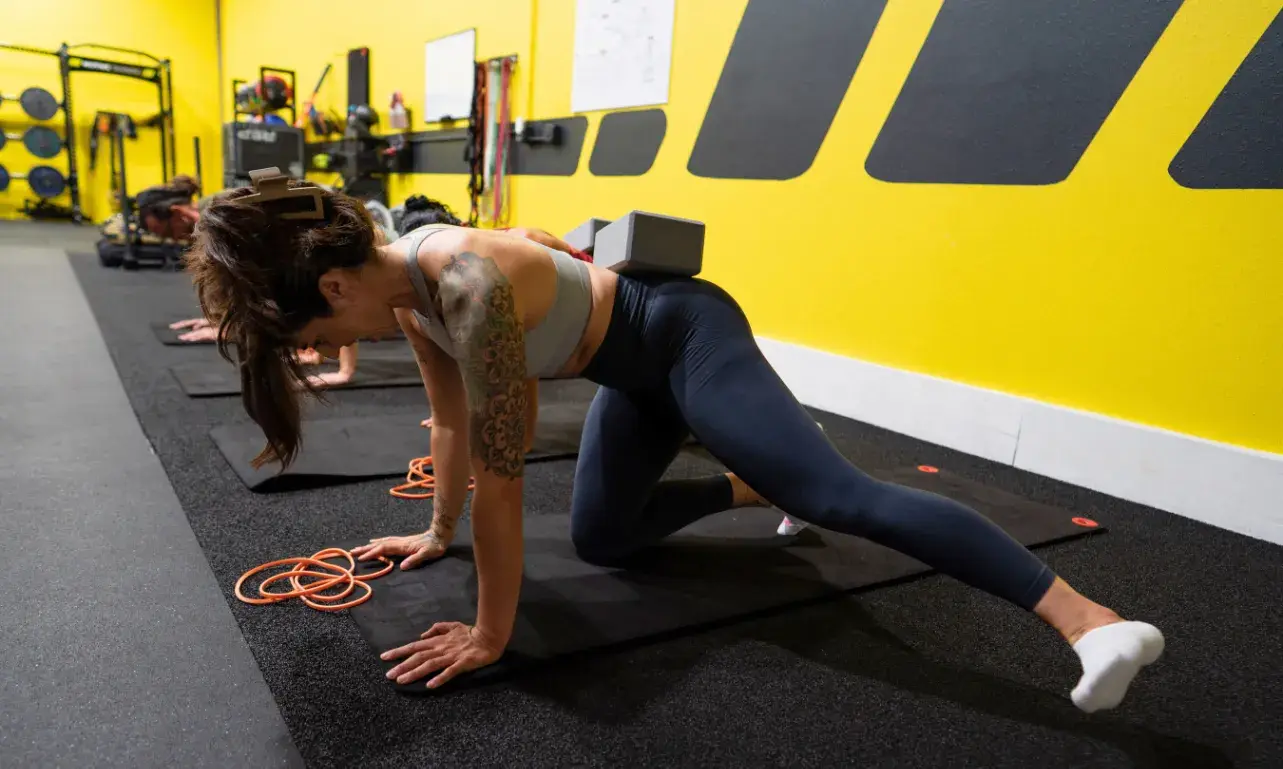
A typical session at Motive looks layered. We use CARs at the start to assess and prep. We program targeted joint work for whatever the assessment showed needs change. Then we train strength and movement using the range we just built, which is the part that locks it in. The hour ends up looking different from a conventional gym session because the early portion is doing something most programs skip entirely. By the time you are loading a barbell, the body is in a position to actually use the range it has.
Where FRC fits in the bigger picture
FRC is not the whole program. It is one of the systems that makes the rest of the program work better. I still program strength training the way most well-built programs do. I still use conditioning, sport-specific work, and skill practice. The reason I lean on FRC is that it gives the body a way to keep adapting to those things over decades, not just months.
This matters more as people get older. The pattern I see most in adults is not a sudden injury. It is a slow loss of options. Joints that used to move start moving less, stiffness becomes the baseline, and training becomes something to survive instead of something that builds capacity. FRC is one of the few systems I have used that actually fights that drift, because it treats joint health as a trainable quality rather than something you wait to lose.
I will say this honestly. As a gym owner, the fact that the industry is still mostly behind on this is good for what we do. It lets us deliver something that the conventional fitness world is not really offering, and that has built the business. At the same time, I would rather see the field catch up. There are too many people stuck doing mobility work that is not producing the changes they were promised, and most of them think the failure is theirs. It usually is not.
What this means for someone trying to move better
If you have been stretching things that will not change, your frustration is reasonable. The feedback loop on most mobility content is broken, because passive stretching does not produce the kind of adaptations that hold. You are not failing the work. The work is asking the wrong things of you.
You do not have to throw out what you are doing. Stretching is fine. So is foam rolling, so is yoga, so is whatever has kept you moving. The shift is adding the layer most mobility content skips. Train the joints actively. Build strength at end range. Use assessment to know what you are actually working on. Give the work enough time to produce a real adaptation.
If you want a structured way to do that, KINSTRETCH is the group format we run that puts FRC principles into a class setting. If you want individual programming, training with us in person or remotely through KINSTRETCH Online is the more specific path. The point is not to sell you on a method. The point is that mobility, like every other quality you can train, responds to work that is built well. Most people just have not seen what that looks like.
Frequently asked questions
Is FRC the same as stretching?
No. Stretching is usually a passive position held to lengthen tissue or increase stretch tolerance. FRC trains the joint, connective tissue, and nervous system together with active contractions at end range. The goal is range you can use under load, not range you can only express on a table.
How long before I see changes from FRC?
Most clients notice changes in joint feel and active control within four to eight weeks of consistent training. Structural changes in connective tissue take longer, usually three to six months. The progress is incremental, and once it is built it tends to hold.
Can I do FRC on my own at home?
CARs work well as a daily home practice. PAILs and RAILs are more effective with cueing and at least an initial assessment, especially when you are starting. We work with clients remotely through KINSTRETCH Online when in-person training is not an option.
Is FRC safe if I have pain or a previous injury?
FRC is generally well suited to training around injuries, because it emphasizes control and progressive loading rather than forcing range. That said, it is not a replacement for medical care. If you are dealing with active pain, an assessment before starting is worth the time, and coordinating with a physical therapist or physician when the situation calls for it is the right move.
Written by

Brian Murray, FRA, FRSC
Founder of Motive Training
We’ll teach you how to move with purpose so you can lead a healthy, strong, and pain-free life. Our headquarters are in Austin, TX, but you can work with us online by signing up for KINSTRETCH Online or digging deep into one of our Motive Mobility Blueprints.