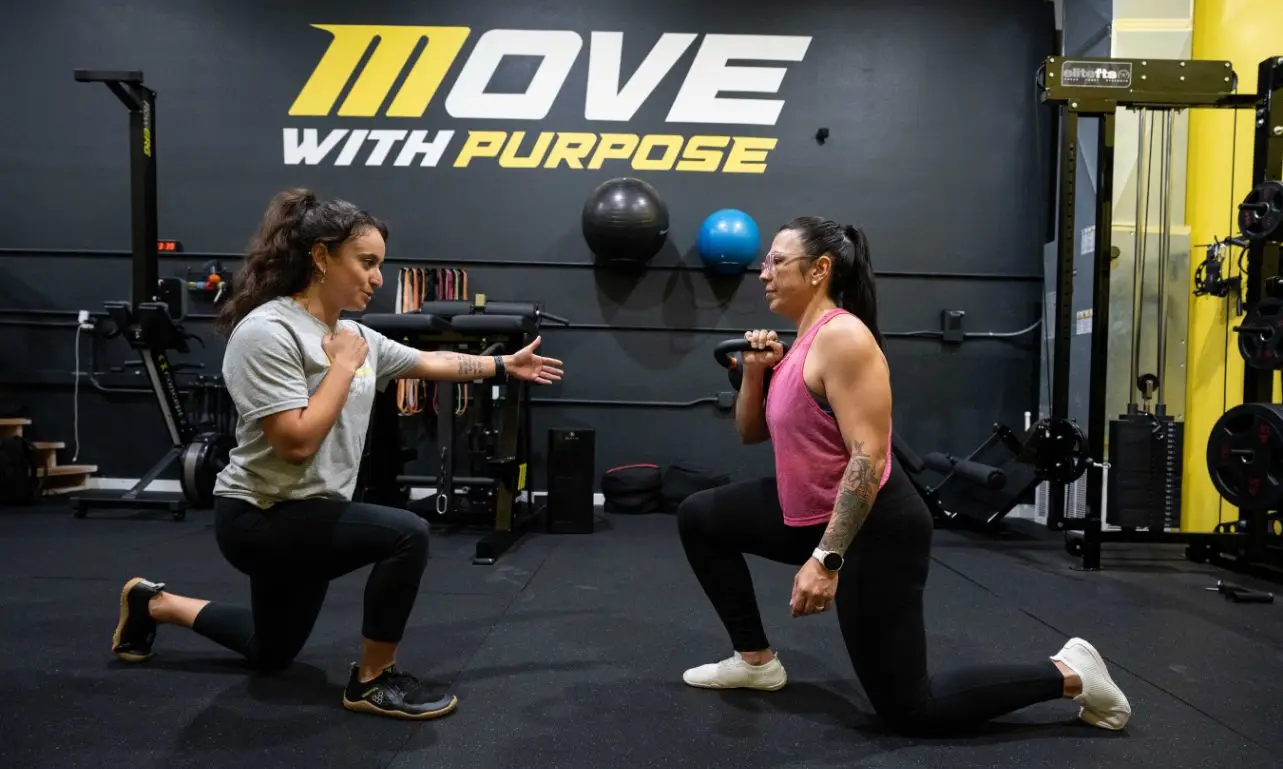
I see the same pattern almost every time someone walks in after an ACL reconstruction. They’ve got their discharge paperwork. They’ve been told they’re cleared. And they still won’t put full weight on the leg coming down a step, or they’ll subtly load the other side during a squat without noticing they’re doing it. Ask them to pivot off that leg quickly and something in their face changes before their body even moves. On paper, rehab is over. In the body, it clearly isn’t.
That gap between “cleared” and “ready” is not a mystery, and it’s not really anyone’s fault, either. It’s mostly a function of how ACL rehab is structured in this country. The research-backed timeline for a full return to sport runs somewhere around 9 to 12 months (1). Most people get 4 to 6 months of covered physical therapy visits for a process that was designed to take twice that long. The PT did their job inside the window they were given. The insurance company set the window, and it ran out first. What’s left over after that window closes tends to fall into four categories: strength that was never fully retested, timing that got compressed under pressure to return, psychological readiness nobody formally checked, and rotational control at the knee that standard rehab rarely trains or assesses at all. That last one gets skipped more than any of the others, and it’s worth spending real time on.
The strength gap that doesn’t get measured
Quadriceps strength symmetry is one of the clearest predictors we have of reinjury risk, and it’s also one of the most inconsistently tracked. In the Delaware-Oslo ACL cohort study, every one percentage point increase in quad strength symmetry between the surgical and healthy leg was associated with a 3 percent reduction in reinjury rate (2). That’s not a small effect over the range that matters. Someone sitting at 70 percent symmetry versus someone at 90 percent is looking at a meaningfully different risk profile, and that gap is common enough that it shouldn’t be treated as an edge case.
The problem is that a lot of clinics never measure it in a way that would catch this. Survey data on return-to-sport decision-making found that nearly half of physical therapists don’t objectively assess quadriceps strength at all, and only about a third are using any kind of instrumented dynamometer to do it (3). Most of what’s happening instead is manual muscle testing: a clinician’s hands assessing resistance, which is useful for a lot of things but isn’t precise enough to catch a 15 or 20 percent deficit that’s still sitting there under the surface. People get discharged strong enough to walk normally and pass a basic exam, which is a different bar than strong enough to decelerate, cut, or land from a jump without the knee buckling inward. Nobody’s lying to the patient here. The measurement just isn’t fine-grained enough to see the thing that actually predicts what happens next.
Timing matters more than people want it to
There’s a real temptation, especially with athletes, to accelerate the return. Nobody wants to sit out a season. But the data on early return is about as clean as sports medicine data gets. The Delaware-Oslo cohort found the reinjury rate dropped by roughly 51 percent for every month RTS was delayed up to nine months, with no additional benefit past that point (2). A separate cohort of young athletes found that returning before nine months carried roughly a seven-fold higher rate of a second ACL injury compared to waiting until nine months or later (4). Seven-fold isn’t a rounding error. That’s the difference between “probably fine” and playing roulette with the same knee twice.
Passing a strength or hop test doesn’t fully cancel that risk out, either. The same young-athlete study found that hitting symmetrical quad strength or hop performance wasn’t enough on its own to offset the danger of returning early (4). Time and tissue healing are doing something biological that a strength number can’t fully substitute for, most likely related to graft maturation and revascularization that simply takes as long as it takes regardless of how strong the surrounding muscle gets in the meantime.
The part almost nobody measures: does the athlete actually believe they’re ready
This is the piece that surprises people. Across a network meta-analysis comparing physical tests, hop batteries, and psychological readiness scales, the psychological readiness measure (the ACL-RSI scale, which tracks confidence and fear of reinjury) was the single strongest predictor of a successful return to sport, with an effect size well above any of the physical tests in the comparison (5). Confidence isn’t a soft add-on here. It’s often outperforming the hop test.
I don’t think that’s mystical. An athlete who’s still bracing, still flinching, still protecting the knee subconsciously is going to move differently under load no matter what the numbers on paper say. Training that range without addressing the guarding pattern just teaches the nervous system to keep guarding. This is also, quietly, one of the better arguments for slow, controlled, joint-by-joint work late in rehab. An athlete who’s spent real time actively exploring end range under control, rather than only being stretched into it by someone else, tends to trust that range more when it shows up unannounced in a game.
The kinetic chain nobody’s watching
Standard rehab is understandably knee-focused, since that’s where the surgery happened. But the mechanism behind a lot of noncontact ACL injuries isn’t isolated to the knee at all. Restricted ankle dorsiflexion changes how the whole lower leg absorbs force during landing; when the ankle can’t fold forward enough, the body compensates with less knee flexion, more ground reaction force, and greater knee valgus displacement, which is more or less the exact position implicated in noncontact ACL tears (6). Weak or poorly controlled glutes create a version of that same collapse from above. So you can rehab a knee in isolation and still leave the athlete standing on a chain that’s set up to fail the same way it did the first time.
The rotation almost no rehab protocol trains directly
Here’s the part that gets left out of most standard timelines entirely, and it deserves more than a passing mention, because it’s central to what an ACL actually does. Knee flexion and extension were never purely a hinge. There’s a smaller, coupled rotation built into the joint called the screw-home mechanism: as the knee approaches full extension, the tibia rotates externally a few degrees relative to the femur and the joint locks into its most stable, weight-bearing position; as the knee bends, the tibia unwinds back into slight internal rotation to unlock it again (7). The ACL isn’t a passenger in that process. It’s one of the structures guiding it, tensioning through the range so that rotation stays coupled to flexion and extension the way it’s supposed to (7).
That’s the reason a torn or reconstructed ACL doesn’t just show up as front-to-back instability. It shows up as loss of rotational control. Research tracking reconstructed knees during high-demand rotational tasks has found that excess tibial rotation is still present after reconstruction even when strength has been fully restored, and this holds regardless of which graft was used (8). Separately, knees with ACL deficiency show measurably more internal tibial rotation during closed-chain movements like a wall squat compared to healthy knees, which interferes with the screw-home locking mechanism itself (9). And clinically, this isn’t a minor footnote: positive pivot-shift testing, a direct marker of persistent rotational instability, shows up in somewhere around a quarter to nearly a third of patients after an otherwise standard ACL reconstruction, and that residual rotational laxity is associated with lower return-to-sport rates and higher reinjury risk (10).
None of this shows up on a goniometer. Flexion and extension range measures clean. Quad strength symmetry can test out at 90 percent. But if the tibia isn’t rotating properly under the femur through that range, the knee is stable in the ways that get measured on a chart and unstable in the exact way that gets tested the moment someone plants a foot and cuts.
This is a big part of why generic quad-and-hamstring strengthening, useful as it is, doesn’t finish the job. Most standard strength work, leg press, quad sets, straight-plane squats, trains the knee to flex and extend under load. None of it specifically trains or assesses the rotational component riding along with that motion. Knee CARs are one of the only tools built to isolate this directly: slow, controlled circular motion at the joint that deliberately works the coupled internal and external rotation most rehab programs never touch on their own, and that gives both the coach and the athlete real information about where that rotational control has gone missing. Here’s how we work knee tibial rotation specifically.
This ties back into the kinetic chain point above, since rotation at the knee never happens in isolation either. What the hip is doing above and what the foot and ankle are doing below both feed into how much rotational demand actually reaches the knee joint, which is one more reason knee-only rehab tends to leave the full picture unfinished.
This is where the CARs and PAILs/RAILs framework earns its place in the conversation, not as a replacement for standard rehab but as the layer that’s usually missing from it entirely. CARs work in early rehab to clear swelling and maintain joint workspace at the hip, ankle, and knee while things are still healing, including that rotational component most protocols ignore. Mid-stage, CARs done under gentle resistance start to surface compensations the athlete’s picked up while protecting the leg, rotational or otherwise. PAILs and RAILs come in to build isometric strength specifically at end range, which is exactly the position most likely to get skipped in a standard strength program built around squats and leg press. Late-stage, loaded CARs push into the outer edges of range, including rotational range, under control, which is where reinjury risk actually concentrates, since that’s the range the athlete hasn’t trusted since surgery.
Passive range isn’t the same thing as owned range
Here’s the distinction that matters most, and it’s the one that gets lost when rehab stops at “full ROM achieved.” Range you can access passively, or even actively at slow speed, isn’t the same as range your nervous system will let you use under the speed and unpredictability of actual sport. Call it borrowed range. It’s there on the goniometer, but nobody’s tested if the athlete can actually own it when a defender cuts left without warning. Most standard rehab protocols end at “full ROM achieved,” full stop. That’s a reasonable place for a clinic to hand off. It’s not a reasonable place to call someone done.
Stu McGill has spent a career pushing people toward stability and control after injury, and there’s real value in that caution; a lot of athletes get hurt because someone rushed them back before their trunk could actually organize force. But the flip side of an anti-rotation, stability-first mindset is that it can leave athletes strong in patterns that never resemble the actual chaos of their sport, knee rotation included. ACL rehab needs both: the control McGill’s world builds, and the exposure to unpredictable, rotational, end-range loading that a lot of protocols never get to because the visits ran out first.
Physical therapists aren’t the problem here. Most of them know exactly what a complete rehab looks like and don’t have the visit count or the reimbursement structure to deliver it. That’s the actual gap. It’s not clinical ignorance, it’s a structural cutoff, and it’s exactly the kind of space personal trainers with the right background are positioned to fill; not diagnosing, not treating, but picking up the strength, control, rotational work, and end-range training that standard coverage runs out before finishing.
If you’re a few months past ACL surgery and the knee still doesn’t feel like yours, that’s worth an actual look before you assume you’re just being overly cautious. We start with a Functional Range Assessment to see where the joint actually stands, rotation included, not where the discharge paperwork says it should be, and build from there. You can get assessed here or schedule a session to talk through where you’re at in the process. And if PAILs and RAILs are new territory, this breaks down how the system works.
The knee doesn’t know what month of the calendar it is. It knows what it’s been asked to do, in every plane it moves in, and if it trusts doing it again.
References
- Physiopedia. “Anterior Cruciate Ligament Rehabilitation.” https://www.physio-pedia.com/Anterior_Cruciate_Ligament_Rehabilitation
- Grindem H, Snyder-Mackler L, Moksnes H, Engebretsen L, Risberg MA. Simple decision rules can reduce reinjury risk by 84% after ACL reconstruction: the Delaware-Oslo ACL cohort study. Br J Sports Med. 2016;50(13):804-808. https://doi.org/10.1136/bjsports-2016-096031
- Ebert JR, et al., cited in: ACL Reconstruction Rehabilitation: Clinical Data, Biologic Healing, and Criterion-Based Milestones to Inform a Return-to-Sport Guideline. Sports Health. PMC9460090. https://pmc.ncbi.nlm.nih.gov/articles/PMC9460090/
- Beischer S, Gustavsson L, Senorski EH, et al. Young Athletes Who Return to Sport Before 9 Months After ACL Reconstruction Have a Rate of New Injury 7 Times That of Those Who Delay Return. J Orthop Sports Phys Ther. 2020;50(2):83-90. https://doi.org/10.2519/jospt.2020.9071
- Integrating psychological and physical assessments to obtain optimal return-to-sport outcomes after ACL reconstruction: a systematic review and network meta-analysis. J Sports Sci. 2025. https://doi.org/10.1080/02640414.2025.2534224
- Fong CM, Blackburn JT, Norcross MF, McGrath M, Padua DA. Ankle-Dorsiflexion Range of Motion and Landing Biomechanics. J Athl Train. PMC3017488. https://pmc.ncbi.nlm.nih.gov/articles/PMC3017488/
- ACL injury and reconstruction: Clinical related in vivo biomechanics, on the ACL’s role guiding the tibiofemoral screw-home mechanism. Clin Biomech. ScienceDirect. https://www.sciencedirect.com/science/article/abs/pii/S187705171000287X
- ACL injury and reconstruction: Clinical related in vivo biomechanics, on persistent excess tibial rotation after reconstruction across graft types. Clin Biomech. ScienceDirect. https://www.sciencedirect.com/science/article/abs/pii/S187705171000287X
- Tibial displacement and rotation during seated knee extension and wall squatting: a comparative study of tibiofemoral kinematics between chronic unilateral ACL-deficient and healthy knees. Knee. PubMed 22854170. https://pubmed.ncbi.nlm.nih.gov/22854170/
- A novel test for assessment of anterolateral rotatory instability of the knee: the tibial internal rotation test (TIR test). J Exp Orthop. 2018. https://doi.org/10.1186/s40634-018-0141-9
Written by

Brian Murray, FRA, FRSC
Founder of Motive Training
We’ll teach you how to move with purpose so you can lead a healthy, strong, and pain-free life. Our headquarters are in Austin, TX, but you can work with us online by signing up for KINSTRETCH Online or digging deep into one of our Motive Mobility Blueprints.