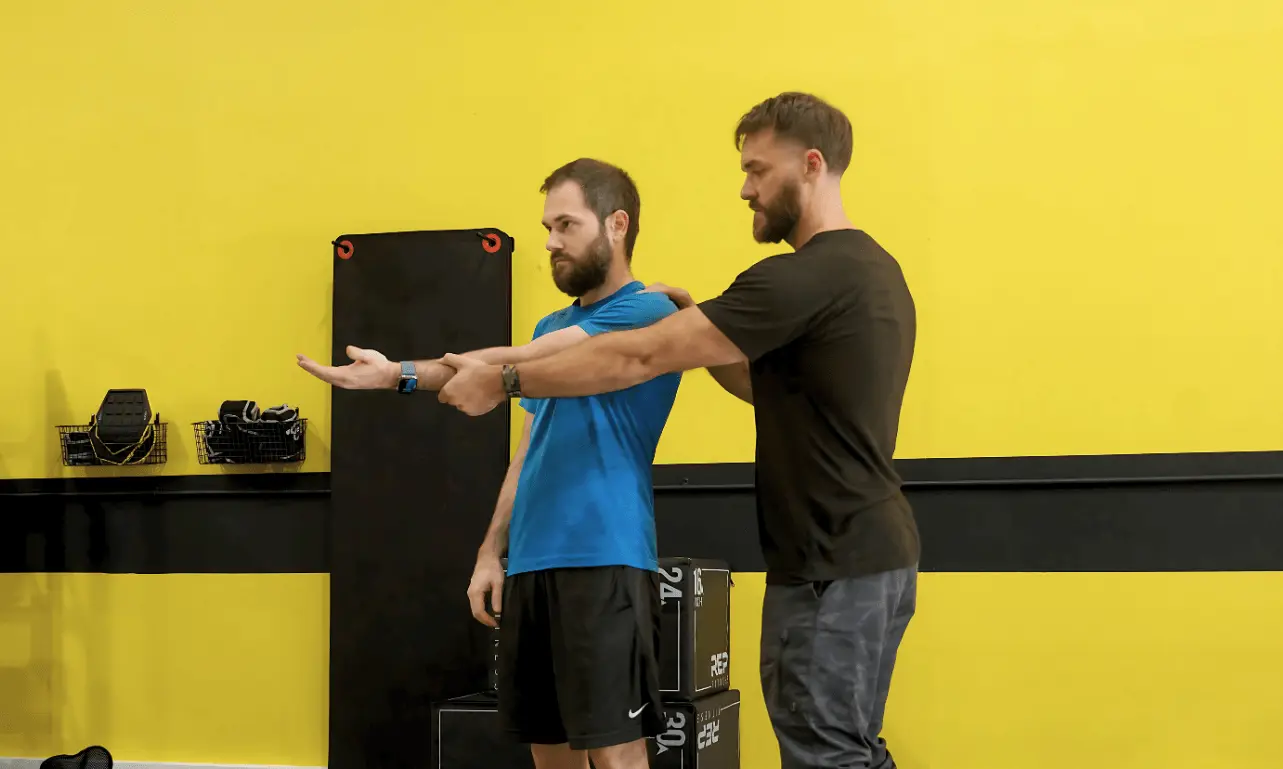
There’s a moment in most people’s first KINSTRETCH class where they realize the thing they thought was a stretch is actually hard work. They get into a deep hip position expecting to sink into it and breathe, the way every stretching class has trained them to, and instead the instruction is to contract, to push, to hold their own weight at the edge of the range under their own muscle. The room gets quiet and a little sweaty. That’s usually the point where it clicks that this isn’t the class they were expecting, and it’s the most honest way I can explain what KINSTRETCH is.
It’s a system, not a routine. Built on the same principles as Functional Range Conditioning, it trains your joints to move through their full range while building strength and control at every point in that range. The difference from a normal stretching class is the whole point, so it’s worth slowing down on.
What KINSTRETCH actually trains
Most people think they need to stretch more to fix their tightness. What they’re usually missing isn’t length. It’s control over the range they already have. You can be flexible and still feel stuck, because flexibility and mobility aren’t the same thing. Flexibility is how far a joint can be moved. Mobility is how far you can move it yourself, with control, under your own power. The gap between those two is where most tightness and a lot of injury risk actually live.
KINSTRETCH closes that gap by training active mobility. Instead of holding a passive stretch and hoping the range carries over to real movement, you work at the edges of your range with muscular effort, which teaches your nervous system that those positions are safe and controllable. The body protectively limits access to ranges it doesn’t trust you to control. Spend enough time demonstrating control at the edge and that protective braking eases up, which is when range starts to feel usable instead of just available.
That’s also why a good KINSTRETCH class is tiring in a way people don’t expect. You’re not sinking into positions. You’re producing tension in them.
Where it shows up in the body
Take the foot, since it’s the one people ignore most. If your foot lacks control, it changes everything above it, because it’s the base of the whole chain when you walk, run, or just stand for a long stretch. A foot that can’t organize itself sends the work upstream to the knee, the hip, the low back. KINSTRETCH trains the joints people normally never train directly, the foot, the spine segment by segment, the wrist, the neck, which is most of why it reaches problems that conventional strength work leaves untouched.
The same logic applies to the spine and shoulders, two regions where a lack of control tends to show up as pain long before anyone connects it to mobility. We train these the way we’d train anything else, with progression and load, not by stretching them and hoping.
Who it’s for
The class fills with a wider range of people than most group fitness, and that’s not an accident. Athletes use it to find control at end ranges their sport demands. Desk workers use it to undo the positions a workday locks them into. People managing old injuries use it to rebuild ranges they stopped trusting. The common thread is wanting more control over your own body, which turns out to be a goal that scales from the post-surgical to the competitive without changing the method underneath.
You don’t need to be flexible to start. That’s one of the more common worries, and it has the logic backwards. The whole point is to build control and range you don’t have yet, so arriving without much of either is the normal starting line, not a disqualifier. We run KINSTRETCH as part of our group programming at the studio in South Austin, and there’s a reason it works better in a group setting than people expect, the pacing and the shared work pull more effort out of you than training alone tends to.
What it isn’t
It isn’t a quick fix, and it isn’t a stretch you do once and forget. The work is about capacity, which is a slower and more durable thing than the loosened feeling you get from a passive stretch and lose by the next morning. We’ve written before about how stretching is closer to training than to a warm-up, and KINSTRETCH is that idea built into a class. You’re investing in control that holds, not chasing a sensation that fades.
That’s also the honest pitch. If you want to feel temporarily loose, there are faster ways to get there. If you want range you can actually use, and joints that hold up to the things you ask of them, that takes showing up and doing the harder version of the work. Living in Austin tends to ask a lot of your body anyway, between the trails, the heat driving people indoors, and the long hours so many people spend at a desk in this town, so the capacity is worth having.
If you’re curious whether KINSTRETCH is the right fit or you’d rather start by understanding where your own gaps are, the movement assessment is the cleaner first step, and it tells us which joints to prioritize before you ever set foot in a class. You can also work the system remotely through KINSTRETCH Online if getting to South Austin on a schedule isn’t realistic.
Written by

Brian Murray, FRA, FRSC
Founder of Motive Training
We’ll teach you how to move with purpose so you can lead a healthy, strong, and pain-free life. Our headquarters are in Austin, TX, but you can work with us online by signing up for KINSTRETCH Online or digging deep into one of our Motive Mobility Blueprints.