People ask why we bother explaining the terminology at all
Someone starts training with us, hears “CARs” or “irradiation” for the first time, and the reasonable question comes up: why not just call it a joint circle and move on. Fair question. The short answer is that the name is carrying information the generic version doesn’t. A joint circle tells you the shape. CARs tells you the intent behind the shape, and the intent is the part that actually changes the outcome. That gap between doing a movement and understanding what it’s doing to your body is where most people’s mobility training stalls out, and it’s the whole reason we built the Learn With Purpose library.
What the library actually is
Think of it as a growing set of breakdowns for the concepts that show up in Motive Mobility programming and in KINSTRETCH classes, written so you can connect what you’re doing in a session to why it’s structured that way, past the point of a one-time glossary skim. It comes free with Motive Mobility, and the idea behind pairing it with the programming is simple: the workouts change how you move, the library changes how you think about why. Clients who understand what’s happening at the joint level tend to stick with the harder parts of this work longer, because they’re not just following instructions, they’re working from a model that makes sense to them.
The core concepts, in short
Controlled Articular Rotations, or CARs, are daily joint maintenance, not a warm-up gimmick. A CAR takes a joint through the largest circle it can actively produce under full muscular tension, and it’s the closest thing this system has to an assessment you run on yourself. Cartilage has no direct blood supply; it depends on synovial fluid circulating through movement to stay nourished. A joint that never reaches its edges loses access to those positions over time, not from injury but from disuse. CARs are how you keep that from happening, and how you find out where it’s already happened. The full breakdown is here.
PAILs and RAILs work on the other side of the same problem. Passive stretching sets a ceiling; it tells you how far a joint can go when something else is doing the work. PAILs and RAILs are how you go claim that range for yourself. You isometrically load the stretched tissue, then the opposing tissue, and you’re teaching the nervous system that you have control at a length it previously treated as unsafe. That’s the actual mechanism behind why a stretch that never gets loaded tends to feel temporary. We go deeper on the programming here.
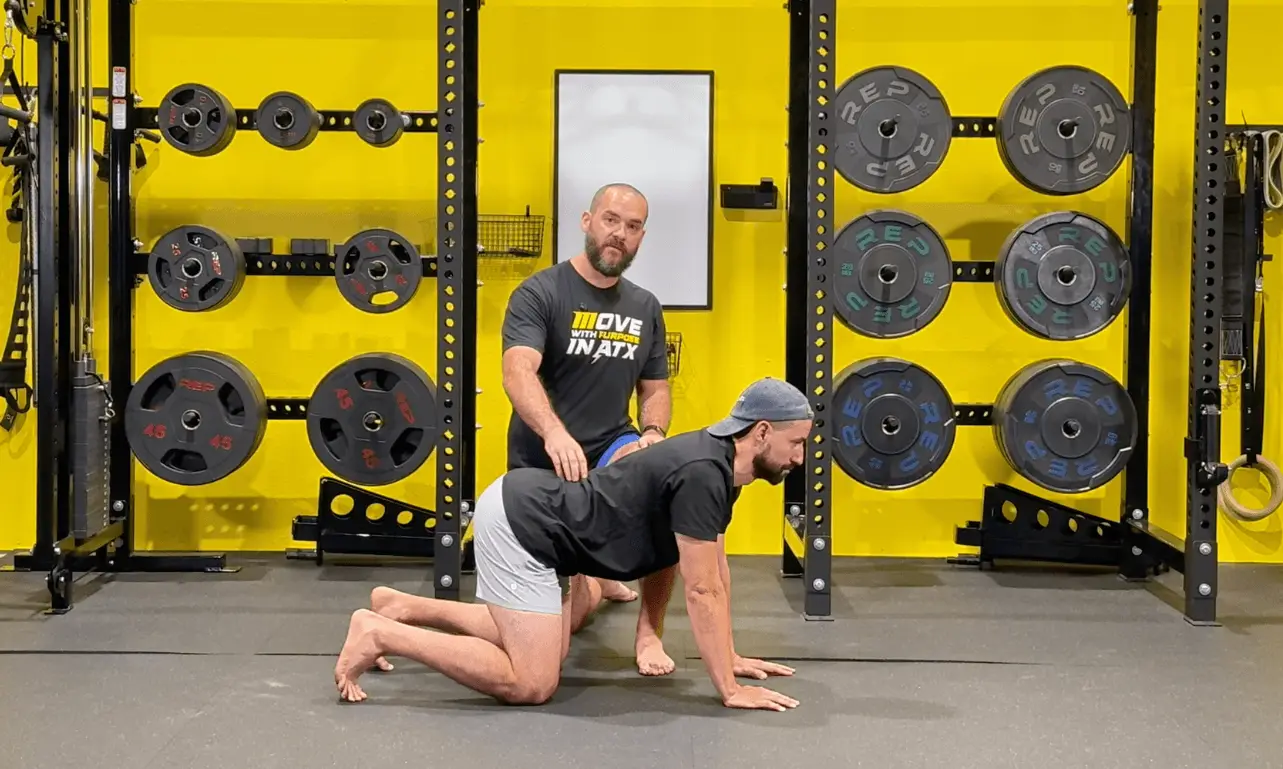
Irradiation is the principle that tension in one part of the body increases neural drive to the rest of it, straight out of Sherrington’s law of irradiation. Grip the floor and brace the trunk during a hip CAR and the hip gets more usable output than it would relaxed, even though the shape looks identical from the outside. It shows up under a squat, in a deadlift setup, in how you carry something heavy off the ground. Once you feel the difference, you stop treating tension as an afterthought.
Not every day needs a full session, which is where Input Sessions come in. They’re short, low-intensity blocks, five to ten minutes, built to give a joint a signal without asking for recovery. They’re structured around intent rather than volume: some are there to open space in the capsule, some to build tolerance in a tissue, some just to keep a nervous system pattern from going quiet between real training days. More on how we use them.
A few more terms you’ll run into inside the library: joint workspace, the usable range you actually own and control in a joint; isometric training, force without movement, used to shore up weak positions; eccentric quasi-isometrics, which blend loaded stretch with strength work; and breathing mechanics, which quietly governs a lot of what shows up as stability or the lack of it.
Why this matters more than it looks like it should
Knowing the mechanism behind a drill changes how you do the drill. Someone who understands that CARs are partly diagnostic pays attention differently than someone going through circles on autopilot. Someone who understands PAILs/RAILs is closing a passive-to-active gap trains end range with intent instead of just gritting through a hold. This isn’t about making clients into practitioners. It’s about giving people enough of the model that the work stops feeling arbitrary, because arbitrary is where consistency dies.
How to actually use it
If you’re training with Motive Mobility from anywhere, use the library as a reference alongside the programming, read the concept before or after the session it shows up in. If you’re in KINSTRETCH Online, pairing the CARs and PAILs/RAILs entries with the classes makes the coaching cues land faster. If you’re training in person in Austin, it’s context for what your coach is already walking you through, not a replacement for it. None of these paths require the others. Pick the one that matches how you train and use the library to fill in the reasoning behind it.
If you’re starting from zero and want a sense of where your own joints actually stand before any of this, the Functional Range Assessment is still the clearest starting point, and from there Motive Mobility and the library work together instead of you guessing which article applies to you.
A few questions that come up often
Who actually gets access to the library
Anyone signed up for Motive Mobility, an in-person client in Austin or someone training with us remotely through KINSTRETCH Online. It isn’t gated further than that.
Do I need to live in Austin to get anything out of it
No. The concepts don’t change based on your zip code. Austin clients can pair the library with in-person coaching and an FRA; everyone else pairs it with KINSTRETCH Online or the Motive Mobility programming itself. Same content, different delivery.
Why give this away instead of charging for it separately
Because a client who understands why a drill is built the way it is gets more out of the drill. Charging extra for that understanding would work against the actual goal, which is people sticking with the harder, less glamorous parts of joint training long enough to see what it does.
I already train at Motive. Is this still useful to me
Usually more useful, not less. Clients who read the relevant entry before or after a session tend to ask sharper questions and self-correct faster, because they’re not just remembering a cue, they’re working from the mechanism behind it.
Is any of this too advanced for a beginner
No. The library is written the same way we coach in the gym: plain language first, technical detail only where it earns its place. Someone brand new to mobility work and someone who’s been doing KINSTRETCH for years will both find something they can use.
Written by

Brian Murray, FRA, FRSC
Founder of Motive Training
We’ll teach you how to move with purpose so you can lead a healthy, strong, and pain-free life. Our headquarters are in Austin, TX, but you can work with us online by signing up for KINSTRETCH Online or digging deep into one of our Motive Mobility Blueprints.