Ask why someone should hire a personal trainer and you get the same answer almost everywhere: motivation, accountability, proper form. All three are real. None of them explain why one person gets lasting results from training and another person, doing the same amount of work with the same amount of accountability, plateaus or gets hurt.
The actual determinant is less visible and rarely discussed. It is if the program was built from an accurate picture of what someone’s body can currently handle, and if it keeps getting adjusted as that picture changes. A trainer who shows up, counts reps, and keeps you accountable to a program that was never built around your actual limitations is providing supervision, not coaching. The difference matters more than almost anything else on the usual list.
Accountability is not the same as effectiveness
You can be extremely consistent with a program that is quietly wrong for your body. Showing up three times a week, pushing hard, and trusting your trainer does not protect you from a program that keeps loading a hip that has never had the rotation to handle it, or a shoulder that compensates every time you press overhead. Consistency amplifies whatever the program actually is. If the program is well matched to what your body can do, consistency compounds into real progress. If it is not, consistency compounds into a problem that shows up later, usually described as coming out of nowhere.
This is why accountability, motivation, and even excellent coaching cues on individual lifts do not guarantee results. They improve execution of the program. They say nothing about if the program itself was the right one to begin with.
Where the actual program should start
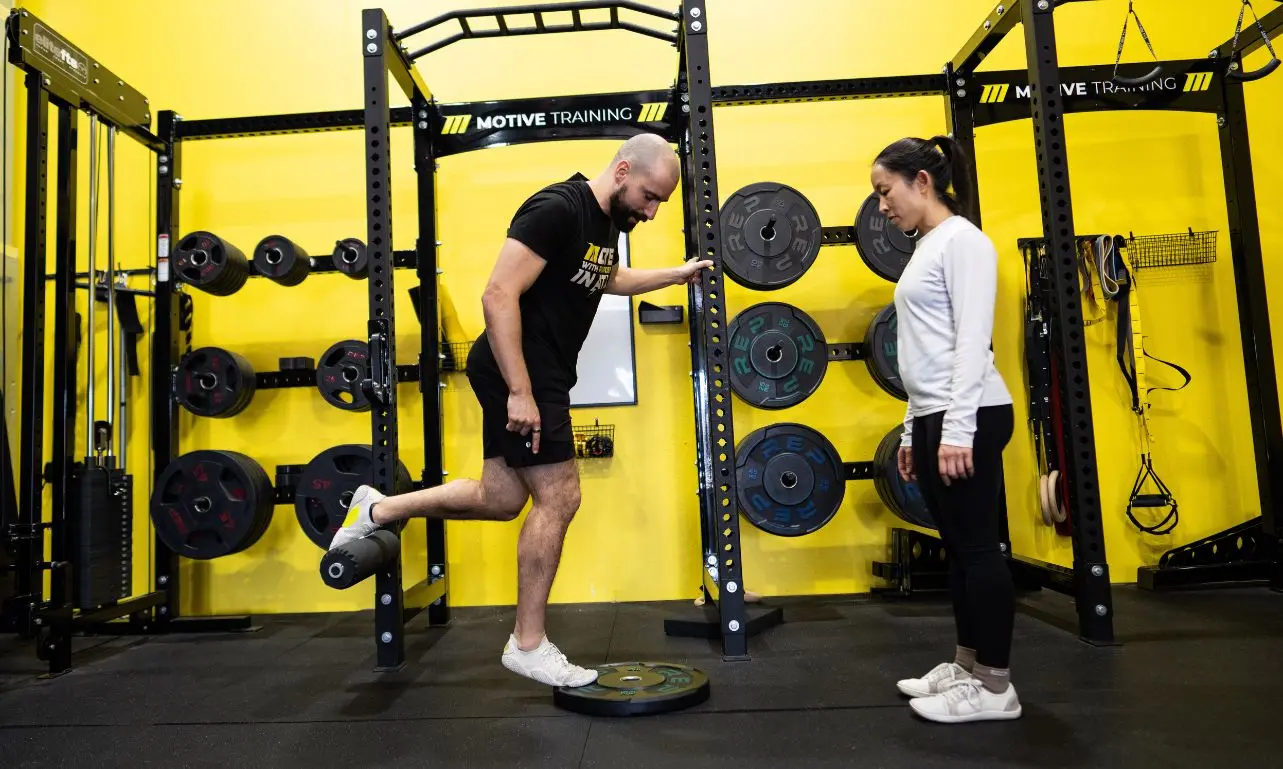
A program built around someone’s stated goal and general fitness level is a guess with good intentions. A program built from an actual Functional Range Assessment, a joint-by-joint look at where someone has range, where they do not, and where they have range they cannot yet control, starts from information instead of a guess. That distinction sounds small until you watch two people with the same goal get handed opposite starting points because their actual limitations were opposite, even though a generic intake form would have sorted them into the same category.
This is the part that separates a trainer’s program from something a person could find online. The exercises themselves are rarely secret. Squats, presses, hinges, carries, most of it is public information. What is not public, and cannot be, is the specific combination of ranges, restrictions, and compensations sitting in front of the trainer on day one.
Progress tracking that actually means something
Most progress tracking in a gym setting asks one question: is the weight going up. That question is useful but incomplete, and leaning on it alone is how people end up adding load to a lift while quietly building a compensation pattern underneath it. A heavier squat with the same knee valgus it had three months ago is not progress. It is the same problem with more weight on top of it.
Real progress tracking asks a second question alongside the first: is the movement itself getting cleaner. Is a joint that used to compensate now holding its own position. Is a range that used to feel unstable now something the person can load with confidence. A trainer who only tracks the number on the bar is missing half of what determines if this training is building something durable or something that eventually breaks down.
What to actually expect from the relationship
A trainer worth paying for should be able to tell you, specifically, why today’s session looks the way it does, and what changed from three weeks ago that led to that decision. If the answer is always some version of we are just progressing you, without reference to anything specific your body has shown them, that is a program running on inertia rather than information.
The same goes for check-ins. A trainer re-assessing periodically, watching for a range that opened up, a pattern that resolved, or a new limitation that showed up, is doing the part of the job that actually justifies the cost. A trainer who runs the same intake once and never checks again is providing a workout with company, which has value, but is not the same service.
The actual answer to if a trainer is worth it
The honest answer is that it depends entirely on which kind of trainer you get. Motivation and form correction are real benefits and worth something on their own. But the version of personal training that produces results holding up over years, not just the eight weeks someone stays motivated, comes from a program built on an actual assessment and adjusted as that picture changes.
If you want to see what that looks like in practice, our personal training approach starts with exactly this, and you are welcome to book a call and see how it would apply to what you are dealing with.
Written by

Brian Murray, FRA, FRSC
Founder of Motive Training
We’ll teach you how to move with purpose so you can lead a healthy, strong, and pain-free life. Our headquarters are in Austin, TX, but you can work with us online by signing up for KINSTRETCH Online or digging deep into one of our Motive Mobility Blueprints.