I spent a good chunk of last year with a stiff neck that I couldn’t fully explain. Nothing traumatic happened. No sleeping wrong, no whiplash, no dramatic gym mishap. Just a slow build of stiffness on the left side that got worse the more I sat down to write programs, answer emails, or scroll through research on my phone. I’m a trainer who understands joint mechanics for a living, and it still took me longer than I’d like to admit to connect the dots. That’s how sneaky this stuff is.
Neck pain is one of the most common complaints I hear, from clients, from friends, from people who find out what I do for a living and immediately want to talk about their neck. And almost every time, the conversation starts the same way: they’ve stretched it, they’ve had a massage, maybe they’ve seen a PT for a few sessions, and the stiffness comes back within a few weeks. That pattern is the actual story here. Not the stiffness itself, but the fact that it keeps returning.
The neck rarely causes its own problem
The cervical spine is seven vertebrae stacked on top of each other, built to support the weight of the head and to move it through flexion, extension, rotation, and lateral flexion, all day, every day. It’s a small, dense structure doing a disproportionate amount of work. But when people show up with neck stiffness, the neck itself is rarely the whole story. It’s usually the last link in a chain that starts somewhere else.
Forward head posture gets blamed for most of this, and the relationship is real, though it’s more nuanced than the posture influencers make it sound. A 2019 systematic review and meta-analysis found a real association between forward head posture and neck pain across a pooled set of studies (1), but the review is also honest that the relationship isn’t purely linear. Posture matters. It’s not the single villain some corners of the internet make it out to be.
What’s more useful, in my experience actually working with people’s necks, is looking one joint down. A 2024 cross-sectional study of 179 young office workers with chronic neck pain found that thoracic spine range of motion had a strong negative correlation with neck disability scores, and that thoracic ROM mediated the effect of cervical ROM on pain severity (2). In plain terms: a stiff mid-back forces the neck to cover for movement it was never built to originate. The neck ends up doing thoracic work on top of its own job. That’s a losing trade for a joint this small.
Why stretching it out doesn’t stick
This is the part that trips people up the most, including past-me. If the neck is tight, stretch it, right? Sometimes that buys a few hours of relief. It rarely buys more than that, and here’s why.
Static stretching mostly works by increasing your tolerance to the stretch sensation, not by permanently lengthening the tissue. Your nervous system controls how far a joint is allowed to move, and it sets that limit conservatively, well short of where tissue would actually be damaged. Stretching can temporarily talk the nervous system into allowing a little more range. But if nothing is done to build strength and control at that new range, the brain doesn’t trust it, and the restriction comes right back. This is the same reason a lot of people can touch their toes after a few weeks of stretching and lose it again a month later if they stop.
The neck is a particularly bad candidate for passive-only approaches because it’s almost never trained through its actual range in the first place. Most strength programs completely ignore cervical flexion, extension, rotation, and lateral flexion as things worth training on purpose. The neck gets stretched when it’s tight and otherwise ignored until it’s tight again.
What actually changes the pattern
Cervical Controlled Articular Rotations are one of the few tools I’ve found that consistently move the needle here, and not because they’re a magic exercise. It’s because they force the neck through its complete available range, slowly and under control, in every plane it’s supposed to move through. That process does two things at once. It restores the nervous system’s map of where the neck can safely go, and it builds strength at the outer edges of that range instead of just visiting them and leaving.
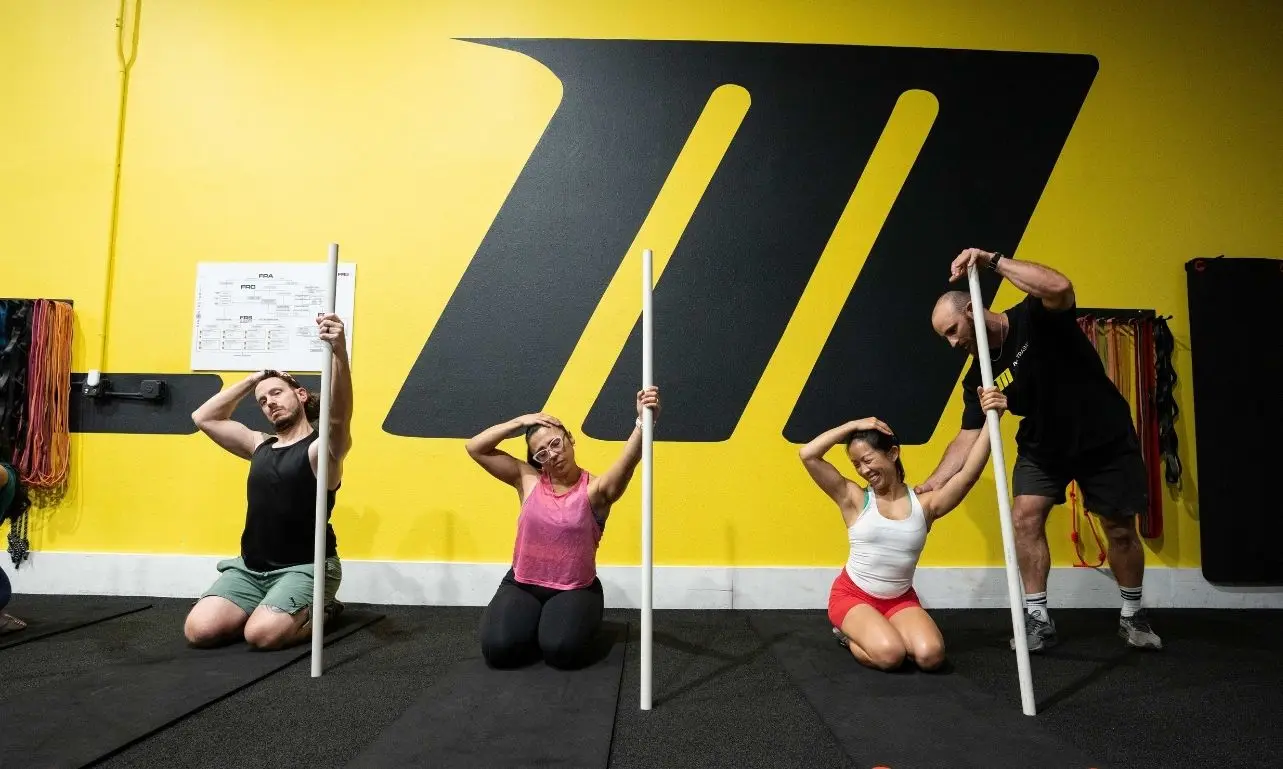
This is the same principle behind KINSTRETCH, which is where I’d point most people who want to actually do something about a stiff, cranky neck rather than manage it every few weeks. A KINSTRETCH class doesn’t treat the neck as an isolated problem. It works the neck alongside the thoracic spine and shoulders, because that 2024 study wasn’t an outlier. The neck rarely fails on its own.
If you’re dealing with genuine restrictions, not just a tight day, a few things are worth doing on a regular basis instead of only when it hurts.
Cervical CARs come first: slow, controlled circles through the neck’s full range, flexion into extension, side to side, and rotation, twenty to thirty seconds per rep, done gently and well inside anything that reproduces pain. Chin tucks (retraction) are the direct counter to forward head posture; draw the chin straight back, not down, as though you’re making a double chin on purpose, hold for a few seconds, and release. And thoracic extension work isn’t optional if you sit most of the day, given how strongly thoracic mobility correlates with neck pain in that 2024 study; rotating and extending through the mid-back regularly takes real load off the neck.
None of this is a one-time fix. The people who actually resolve chronic neck stiffness are the ones who build these into a routine, not the ones who do a stretch once when it flares up.
What’s actually worth checking
If your neck has been a recurring problem for months or years, guessing at which range is restricted isn’t a great use of your time. A Functional Range Assessment maps exactly where the neck, thoracic spine, and shoulders are losing active control, so training gets pointed at the actual restriction instead of the whole area in general. That’s especially true for anyone spending most of the day at a desk. The pattern with tech workers shows up almost identically from client to client, and the neck is rarely the only joint involved.
I still get a tight left side of my neck now and then. The difference is I know why, and I know what to do about it before it turns into three weeks of not being able to check my blind spot.
References
- Mahmoud NF, Hassan KA, Abdelmajeed SF, Moustafa IM, Silva AG. The Relationship Between Forward Head Posture and Neck Pain: a Systematic Review and Meta-Analysis. Curr Rev Musculoskelet Med. 2019.
- Kuligowski T, Skrzek A, Cieślik B. Influence of Sagittal Cervical and Thoracic Range of Motion on Neck Pain Severity in Young White-Collar Workers: A Cross-Sectional Study. J Clin Med. 2024.
Written by

Brian Murray, FRA, FRSC
Founder of Motive Training
We’ll teach you how to move with purpose so you can lead a healthy, strong, and pain-free life. Our headquarters are in Austin, TX, but you can work with us online by signing up for KINSTRETCH Online or digging deep into one of our Motive Mobility Blueprints.