Most of the people who ask me about PAILs and RAILs already know the protocol. They can recite it. Two minutes in the stretch, ramp the contraction into the lengthened tissue, switch sides, try to pull deeper. They’ve watched the videos. What they can’t tell me is how often to do it, how many rounds, where it sits in their week, or how to know when they’ve earned the right to move on. That’s the actual problem with this work. The technique is the easy part. The programming is where it falls apart, and where the range you worked for either sticks or evaporates by next week.
So this isn’t another explainer on what the acronyms stand for. If you want the mechanism, we’ve covered why end-range isometrics convert passive range into usable range and what the research actually supports elsewhere. This is about how to run it.
Start with the question the technique can’t answer on its own
PAILs and RAILs exist to close a specific gap. You have a passive range your body can be placed into, and a smaller active range you can get to and control on your own. The space between those two is the thing we’re training. Before you program a single round, you have to know how big that gap is, because the size of the gap decides almost everything about how you’ll dose the work.
If someone can passively get their leg into deep hip flexion but actively can’t get within thirty degrees of it, that’s a large gap, and it changes the priority. A large gap means the nervous system is doing a lot of protective braking, and it means loaded movement through that range is premature. You don’t load what you can’t control. In our framework that’s exactly when PAILs and RAILs take priority over everything else, including loaded progressions, because there’s no point strengthening a range the person can’t actively own yet. You earn the range first.
When the gap is small, the calculus flips. The person already has decent active control, and the isometric work becomes maintenance and incremental expansion rather than the main event. Same technique, completely different role in the program.
The dosage that actually works
This is low-volume work, and people consistently get that wrong. The instinct is to treat it like a set of curls and chase rounds. One to three rounds per position is the working range, and most of the time two is right. Past that you’re not adding stimulus, you’re adding fatigue, and fatigue is the enemy here because the contractions have to be near-maximal to do their job. A tired contraction at end range is a wasted contraction. If you can’t ramp to something close to a real effort, you’re done for that joint, regardless of what the plan said.
The contraction itself ramps gradually to somewhere around seventy to a hundred percent effort and holds for ten to twenty seconds. The gradual build isn’t a stylistic choice. You’re loading tissue in a lengthened, vulnerable position, and a sudden yank into a hard contraction is how people hurt themselves doing the exact thing meant to bulletproof them. Ramp in, hold, ramp out. The breathing stays controlled the whole time. People want to brace into a full breath-hold to generate more force, and that’s the wrong trade at end range.
Expect cramping. A deep position with a near-max contraction will cramp, especially in the hamstrings and hip rotators, and that cramping in a lengthened position is normal. It isn’t an injury and it isn’t a sign you’ve gone too far. It’s the contractile tissue working at a length it almost never gets asked to work at. It passes.
Where it sits in the week
Two to three exposures per joint per week is plenty for most people, and the joints you train don’t all have to be the same ones each session. The work is demanding enough that hammering the same hip every day produces worse results than spacing it out, because you’re asking for a near-maximal effort and the tissue needs to recover between bouts the same way it would from any heavy isometric.
Within a single session, this belongs early, before the fatiguing work, not tacked onto the end of a brutal training day when you’ve got nothing left to contract with. I know that contradicts how most people use mobility work, as the cool-down afterthought we’ve argued against before. But if the contraction quality is what drives the adaptation, and it is, then doing it depleted is doing it badly. Treat it like the priority it is when the gap is large. Put it where you have the output to do it well.
The progression nobody sequences correctly
Here’s where most self-directed mobility work stalls. People do PAILs and RAILs, feel a little deeper, and then either stop or immediately try to load the new range with full movement. Both are mistakes. The range you just accessed is fragile. You proved to the nervous system you have some control there, but you haven’t built durable, repeatable control yet.
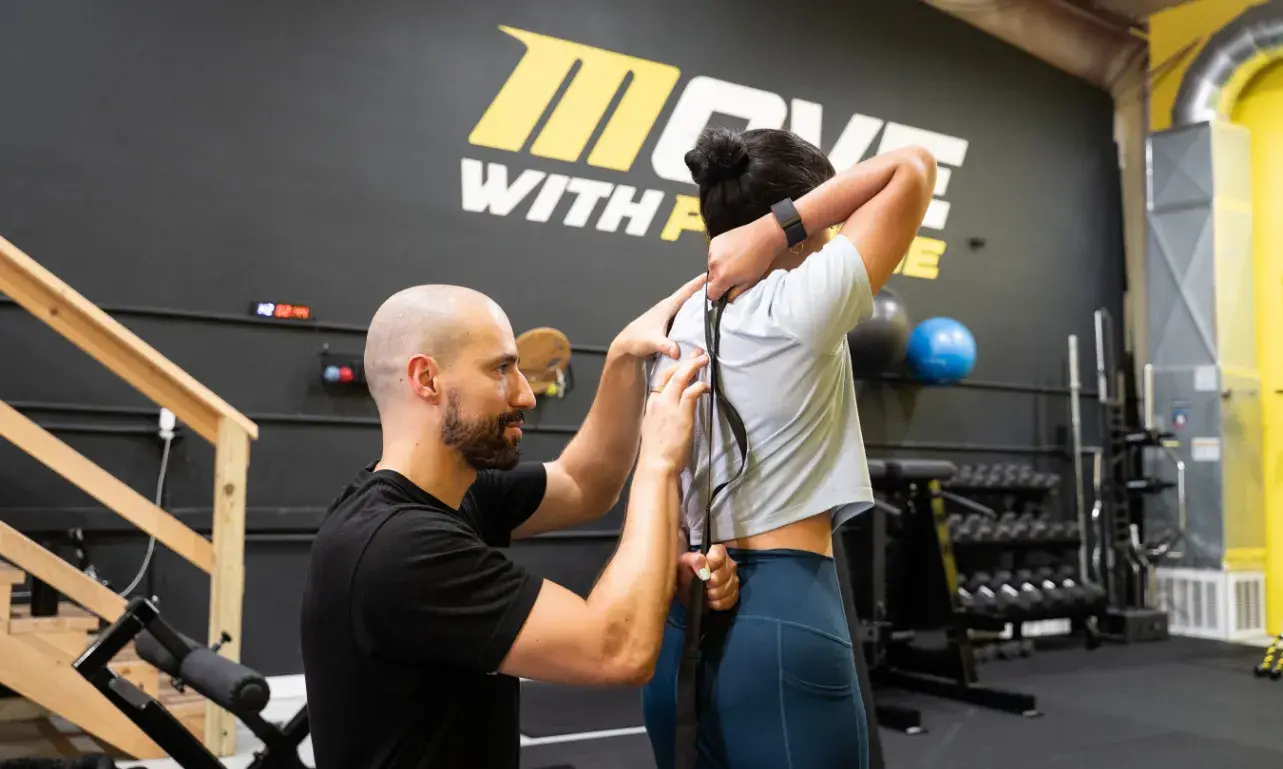
The bridge between the isometric work and loaded movement is the passive range hold. You take the end range you just expanded, get placed into it, and then hold that position with nothing but your own muscle. No external support, no help. For a shoulder, that’s getting the arm into its new overhead position and sustaining it there under active control alone. It’s the simplest, safest way to start owning a range when active control is still limited, which is exactly why it comes after PAILs and RAILs rather than instead of them. The isometrics expand and signal control at the edge; the hold teaches you to keep yourself there without assistance.
Only after the hold gets honest, meaning you can actually sustain the position without shaking apart, does loaded movement through the range earn its place. That’s the order. Isometric loading to expand and claim the range, passive range holds to build active ownership of it, then loaded movement to make it robust. Skip the middle step and you’re loading borrowed range, which is how people end up overloading joints in positions they don’t control.
How to know it’s working
You’re not measuring this by how the stretch feels. Stretch tolerance improves fast and means very little on its own. What you’re tracking is whether the active range is catching up to the passive range. Can the person get closer to that deep position on their own than they could a month ago. Can they hold it longer without external support. That closing gap is the entire point, and it’s the only metric that tells you the range is becoming usable rather than just accessible.
Progress is slower than passive stretching makes you feel, and that’s the honest trade. You’re not chasing the temporary loosened sensation. You’re building something that’s still there next week. From what I’ve seen, the people who get the most out of this are the ones who do less of it than they expected, do it when they’re fresh, and respect that the contraction quality matters more than the round count.
If you want eyes on your own passive-to-active gap before you start programming blind, that’s most of what the assessment is for, and it’s the difference between training the joint that actually needs it and guessing. You can also work the full progression in a structured class setting through KINSTRETCH Online, where the dosage and sequencing are already built in.
Written by

Brian Murray, FRA, FRSC
Founder of Motive Training
We’ll teach you how to move with purpose so you can lead a healthy, strong, and pain-free life. Our headquarters are in Austin, TX, but you can work with us online by signing up for KINSTRETCH Online or digging deep into one of our Motive Mobility Blueprints.