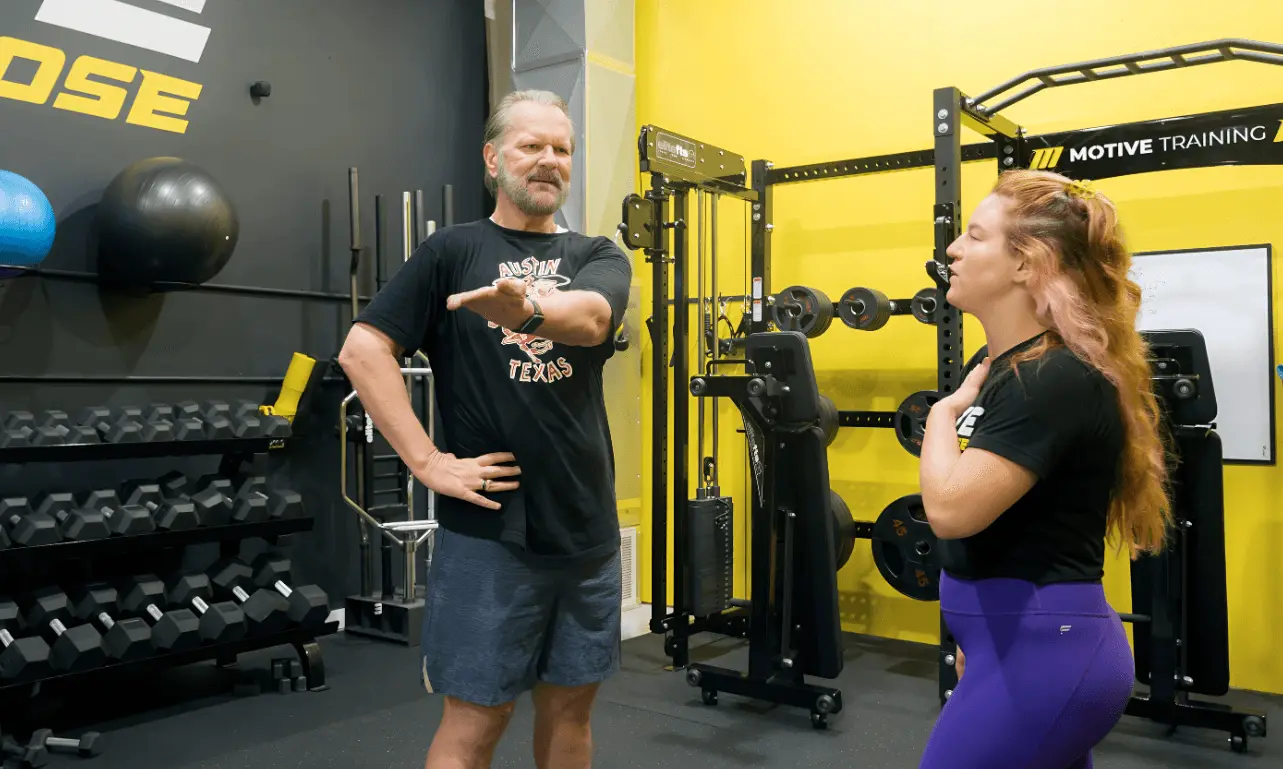
Should you work with a local personal trainer
The internet has no shortage of workout plans. Most of them are fine. A lot of them will get a reasonably healthy person moving more than they were before, and that’s worth something. The honest argument for working with a local trainer isn’t that online programs are useless. It’s that they can’t see you.
That gap matters more than people realize. A program doesn’t know that your left hip locks up when you squat past 90 degrees. It doesn’t know that your shoulder flares up any time you press overhead, or that the thing you said you fixed in physical therapy two years ago is still changing how you move. The trainer in the room with you does. That’s the real case for working with someone local: not motivation, not accountability (though both help), but information that a screen can’t capture.
What a local trainer can actually do that a remote program can’t
There’s a category of problem that only becomes visible in person. You think your hips are the issue; the trainer looks at your ankle mobility and realizes that’s where the pattern starts. You think you’ve been doing the movement correctly for years; the trainer watches three reps and identifies a compensation that’s been loading your lower back in a way that’s finally catching up with you.
This isn’t about the trainer being smarter than you. It’s about what’s observable. Remote coaching has gotten genuinely good at a lot of things, and I wouldn’t dismiss it for the right person in the right situation. But there are real limits to what video can show, and even more limits to what you can self-report accurately about your own movement.
At Motive, every new client starts with an assessment for exactly this reason. Before we write anything, we need to see how your joints actually move, not what you think they do or what you’d like them to do. The Motive Movement and Mobility Assessment is that starting point. It’s not a formality. It’s the only way we can build something that actually fits.
The role of methodology
Not every trainer is working with the same tools, and this is worth paying attention to when you’re evaluating who to work with.
At Motive, we use Functional Range Conditioning as the foundation of how we assess and train. FRC is a system built around joint health, usable range of motion, and the neurological control required to access that range under load. It’s not a philosophy or a brand. It’s a set of assessment and training tools that let us be precise about what’s limited, why it’s limited, and what to do about it in a sequence that makes sense. The emphasis on end-range strength and active control separates it from most mobility work you’ll find in general fitness settings.
This matters when you’re shopping for a trainer because “I do mobility work” can mean almost anything. Foam rolling counts. Static stretching counts. So does FRC-based end-range loading. These are not equivalent, and the distinction between temporary relief and actual capacity change is real.
Accountability has a texture to it in person
The accountability benefit of working with a trainer is real, but it’s often described in a way that undersells it. It’s not just that you show up because you paid. It’s that someone who knows your training history, your injury patterns, your goals, and your current sticking points is in the room every session adjusting the work in real time.
Progress in training is nonlinear. There are weeks where the plan needs to change because you slept terribly, or your body is responding to a new stimulus in a way that wasn’t expected, or life has compressed your recovery window. A good trainer reads that and responds. A program doesn’t.
If you’re someone who trains consistently and adapts well to self-directed work, local training might not be your highest priority. If you’ve been stuck, dealing with recurring pain, or haven’t been able to translate effort into results, working with someone who can actually see what you’re doing is almost always the faster path.
What to actually look for in a local trainer
The credential landscape in personal training is wide. There are certifications that require meaningful study and ongoing education, and there are weekend certifications that don’t. Looking for FRC credentials (FRCms, FRSC, FRA) or similar systems that emphasize joint assessment and controlled loading is a useful filter; it tells you the trainer has invested in understanding the specifics of how the body moves rather than just how to run someone through a workout.
Experience working with the kind of problems you bring matters too. A trainer who primarily works with high-level athletes and a trainer who primarily works with general population adults dealing with desk-related pain are going to approach your intake differently. Neither is wrong, but they’re not interchangeable.
Reading reviews is useful, but look for specificity. Generic praise tells you little. Reviews that describe how the trainer handled a specific problem, adapted a program, or addressed something the client didn’t expect are more informative.
Group mobility as an entry point
If you’re not sure where to start, or you want to experience the FRC approach before committing to one-on-one work, KINSTRETCH is a reasonable first step. It’s a group class built around the same principles: joint control, controlled end-range loading, and week-to-week progression rather than random movement variety.
It won’t replace an individual assessment, but it will give you a clear sense of where your body’s gaps are and introduce you to the system before a camera or a trainer is focused only on you. For people who train well in a group environment and are looking for structured mobility work, it’s also a complete option in its own right.
The question worth asking
The real version of the question isn’t “should I hire a local personal trainer?” It’s “what’s the thing I can’t figure out on my own, and does a local trainer with the right expertise solve it?”
For some people, the answer is: no, they have what they need. For most people dealing with pain, stuck progress, or a pattern of doing the work without getting the result, the answer leans toward yes. The variable is finding the right person; not just someone nearby, but someone with the tools and knowledge to actually address what you’re dealing with.
If you’re in South Austin and want to understand what that looks like in practice, reach out. We can talk through what you’re working on and point you toward the right starting point.
Written by

Brian Murray, FRA, FRSC
Founder of Motive Training
We’ll teach you how to move with purpose so you can lead a healthy, strong, and pain-free life. Our headquarters are in Austin, TX, but you can work with us online by signing up for KINSTRETCH Online or digging deep into one of our Motive Mobility Blueprints.