Almost everything written about training is about what to do. Do these reps, hold this position, train this range. Very little of it explains what is physically happening inside the joint while you do it, which is strange, because that is the part that actually makes the case. A joint is a living environment, not a fixed hinge with a set amount of grease. It responds to what you ask of it, feeds itself through movement, and remodels around the demands you place on it or fail to. Once you understand what is going on in there, the reason to train the way we train stops being a slogan and starts being obvious.
How a joint feeds itself
The cartilage lining the ends of your bones has no blood supply of its own. There is a reason for that. Cartilage has to be smooth and slick enough to let a joint glide, and blood vessels running through it would compromise that. But it creates a problem the body has to solve another way. Cartilage gets its nutrients from synovial fluid, the fluid inside the joint capsule, and that fluid only gets pressed into and out of the cartilage when the joint moves through its range under load. Movement is how the joint eats.
That has a consequence most people never hear. A range you never visit is a range you are slowly starving. If your hip has not seen the end of its rotation in years, the cartilage in that zone is not being fed the way the cartilage in your mid range is, and tissue that goes unfed does not stay healthy forever. At the joint level, use it or lose it is close to a literal description of how cartilage is maintained, not a motivational phrase. This is a large part of why a daily practice like Controlled Articular Rotations matters more than it looks like it should. Taking every joint through its full range each day is, in part, feeding tissue that your normal habits skip.
The capsule remodels around what you ask of it
Surrounding each joint is a capsule, a sleeve of connective tissue that holds the joint together and helps define how far it can go. That capsule is not a fixed boundary you were issued at birth. It remodels. It adapts to the ranges you regularly ask it to control, and it tightens around the ranges you abandon. Spend years never taking a shoulder overhead with control and the capsule slowly organizes around that smaller working range, which is why the restriction eventually feels structural rather than like simple tightness. In a small way, it has become structural.
The encouraging half of that is that remodeling runs both directions. The same capsule that tightened around a range you stopped using will gradually reorganize around a range you start training, provided you give it a real reason to. That reason is load, which is the next piece.
Connective tissue answers to load, not to lengthening
Here is where a lot of stretching goes sideways. Connective tissue, the collagen in your capsule, tendons, and the structures around the joint, remodels in response to mechanical load. It lays down and organizes its fibers along the lines of stress you actually put through it. Passive stretching, for the most part, does not deliver that signal. It changes how a position feels by turning down the nervous system’s alarm, but it does not give the tissue a strong enough load to reorganize around. That is why the range you stretch into tends to leave by tomorrow.
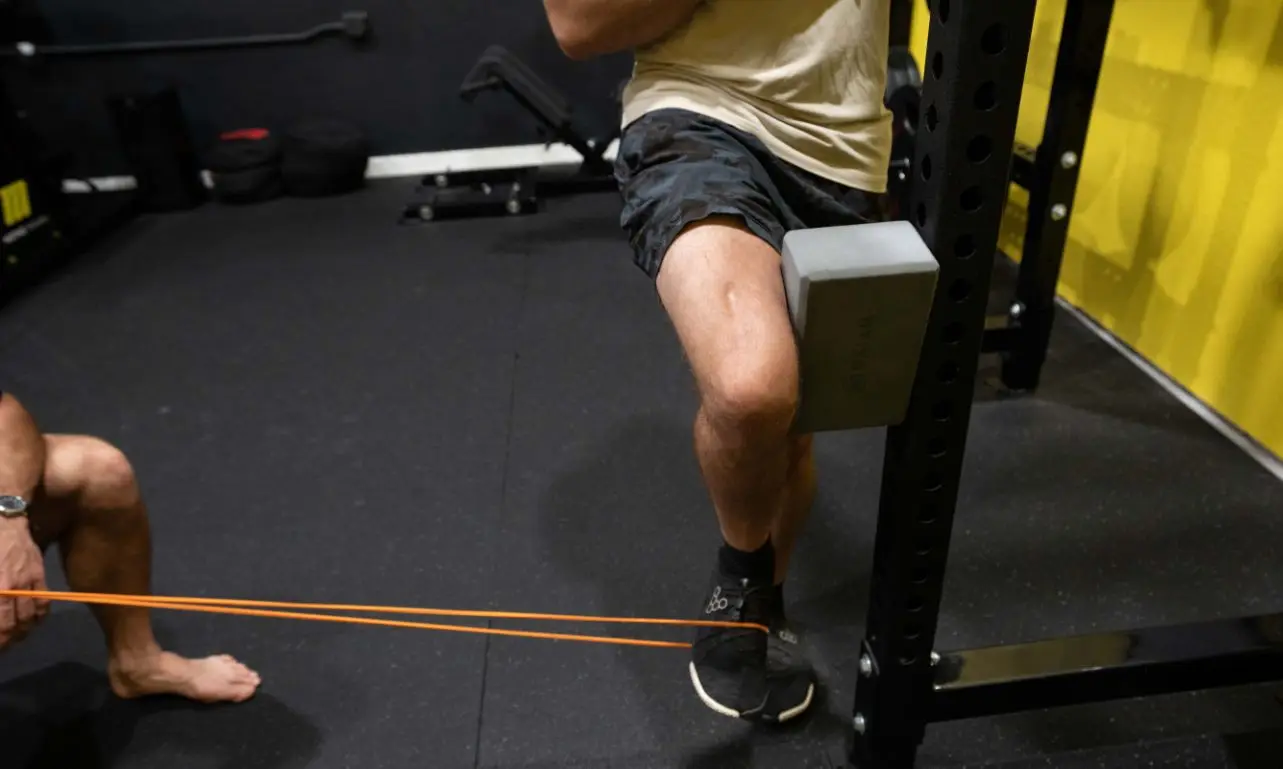
Loading a joint at the edge of its range is what changes this. When you produce force at end range, through the kind of work covered in end-range training, you are giving the connective tissue the mechanical signal it needs to adapt, and you are giving it in the exact position you want to keep. This is the mechanism under the whole Functional Range Conditioning approach: build the tissue where you want the range, with load, so the change is structural and stays.
The joint your brain keeps a map of
The last piece is the one people find hardest to believe, and it might be the most important. Your nervous system keeps a map of every joint, a sense of where it is and how much of it you can safely control. That map gets more detailed with use and blurrier without it. When a joint spends years in a narrow range, the brain’s picture of the rest of that joint degrades, and the brain will not let you actively use a range it no longer has a clear picture of. It guards it instead, and you feel that as tightness or weakness at the edges.
A surprising amount of what gets written off as aging is this map going blurry rather than the tissue wearing out. The map is trainable. Slow, controlled movement through the full range, with attention, is how you redraw it, which is another reason CARs and deliberate end-range work do more than they appear to. You are not just moving the joint. You are reminding your brain that the joint exists.
Why this changes the point of the work
Put those four things together and the goal of mobility training looks different than the usual pitch. The work is feeding cartilage your habits have been starving, giving the capsule a reason to remodel around more range, loading connective tissue so the change is structural, and keeping your brain’s map of the joint sharp. That is the difference between a joint that still works at seventy and one that does not, and none of it is cosmetic.
It is also why the honest first step is finding out which of your joints are actually being neglected, since it is rarely the ones you would guess. If you want that picture, getting assessed is where it starts. The rest is showing up and giving the tissue, day after day, the inputs it has been missing.
Written by

Brian Murray, FRA, FRSC
Founder of Motive Training
We’ll teach you how to move with purpose so you can lead a healthy, strong, and pain-free life. Our headquarters are in Austin, TX, but you can work with us online by signing up for KINSTRETCH Online or digging deep into one of our Motive Mobility Blueprints.