I have watched a lot of people work genuinely hard in the gym for a year and end the year in roughly the same place they started. They showed up. They were not lazy. They were not undisciplined. They did a session, and then a different session, and then another one, and none of the sessions knew about each other. A year of effort that never pointed anywhere.
That is the thing a fitness program actually fixes, and it is worth being clear about, because the usual pitch for programs is about motivation and accountability. Those have their place. But the core problem with training without a program is not that people lose interest. It is that disconnected workouts do not compound. Each one is fine on its own and the year still goes nowhere.
Training only counts when it accumulates
The body adapts to a stimulus that repeats and progresses. That is the entire mechanism. You ask it to do something slightly demanding, you ask again before the adaptation fades, and you ask for a little more over time. Strung together, that is how a body changes. Skip the through-line and you are not really training, you are just exercising, and the two are not the same thing.
A random session burns some energy and feels productive in the moment. It rarely builds on the last one, because the last one was a different exercise at a different intensity aimed at a different quality. The work does not stack. A program is the thing that makes it stack. It decides what you are progressing, how fast, and in what order, so that month six is built on month five instead of starting over.
This is also why the “just move more” advice, while not wrong, quietly disappoints people. Movement is good. But movement without direction has no target to organize around, and a body with nothing to organize around tends to drift back to whatever it could already do. Effort is the raw material. A program is what turns it into a result.
A program is only as good as what it is built on
Here is where most programs, including a lot of paid ones, fall short. They are built on a goal and not much else. The goal might be real. But a goal is not enough information to write a good plan, because two people with the same goal can need almost opposite work to get there.
Take “I want to move better and stop feeling stiff.” One person saying that has plenty of range and no control of it. Another has genuinely limited range. A third has fine range and fine control and a coordination problem dressed up as stiffness. Same sentence, three different bodies, three different programs. A plan written off the goal alone will serve one of them well and the other two poorly, and the other two will assume they failed the program when the program never actually fit them.
This is why a real program starts with finding out what is true about the specific body in front of you. Not a generic intake form and a few questions, but an actual look at how your joints move, where you have control and where you do not, what your range will and will not do under load. That is the job of an assessment. The Motive Movement and Mobility Assessment gives a clear picture of where your mobility, control, and movement quality actually stand, and that picture is what a program should be written from. Skip it and you are guessing, even if the guess is dressed up in nice formatting.
What “fitness” should even mean here
There is a quiet assumption baked into most programs that fitness means a familiar short list, get stronger, get leaner, get your conditioning up. Those things matter. But framed narrowly, that list trains you to be good at the gym, which is not the same as being good at being a body.
The body is built to rotate, to organize the trunk and hips together, to walk and run and absorb force and produce it in directions a barbell never asks for. A program built only around squat, press, and run will improve those three things and leave real gaps in everything around them. A better program treats strength and conditioning as part of the picture, not the whole definition, and includes the qualities that keep you capable and out of pain over decades. Mobility you can control, the kind built through real mobility training rather than a few stretches tacked onto the end. Trunk and hip coordination. The ability to handle range, not just load. That fuller view is the difference between a program that makes you fit for a season and one that makes you durable for a long time.
What a coach actually does inside a program
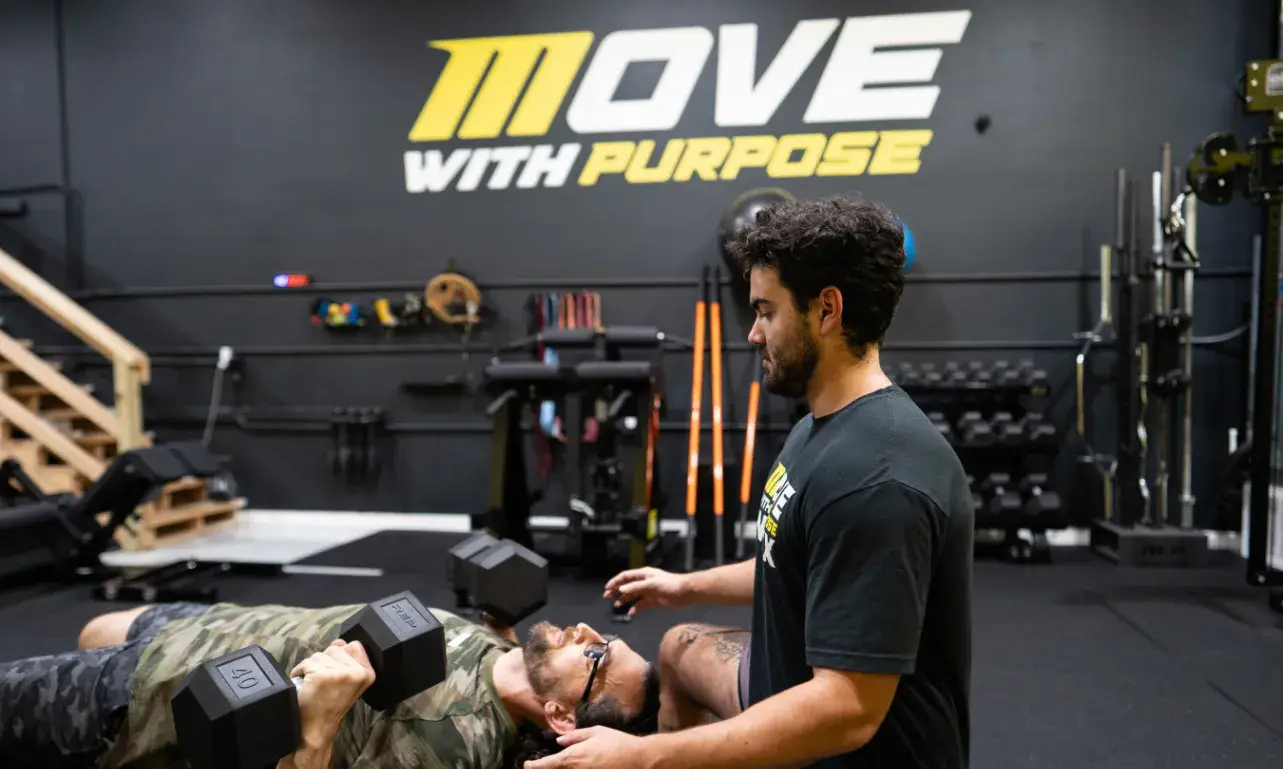
A program on paper is a plan. A program with a coach attached is a plan that adjusts to reality, and that is most of the value.
A coach watches the work happen, which is where the useful information is. A plan cannot see that your left hip is doing something your right hip is not, or that a lift you should be progressing is the one quietly going backward. A coach catches that and changes course before it becomes a problem. A coach also calibrates honestly. The plan should be demanding enough to drive adaptation and not so demanding that it breaks you down faster than you recover, and finding that line is a read on the actual person, not a formula. And yes, a coach keeps you accountable. But the version of accountability worth paying for is not someone counting your absences. It is someone whose read on your training is sharp enough that the sessions are pointed at the right thing every time you walk in.
Where it starts
If you have been training hard without much to show for it, the missing piece is usually not effort and not willpower. It is direction, and direction is something a program supplies and a pile of separate workouts cannot.
The honest first step is not picking a program. It is finding out what your body actually needs one to do. If you want to start there, you can schedule a session with us and we will begin with an assessment, build the plan from what we find, and adjust it as you change. That is what makes a year of training turn into a year of progress instead of a year of showing up.
Written by

Brian Murray, FRA, FRSC
Founder of Motive Training
We’ll teach you how to move with purpose so you can lead a healthy, strong, and pain-free life. Our headquarters are in Austin, TX, but you can work with us online by signing up for KINSTRETCH Online or digging deep into one of our Motive Mobility Blueprints.