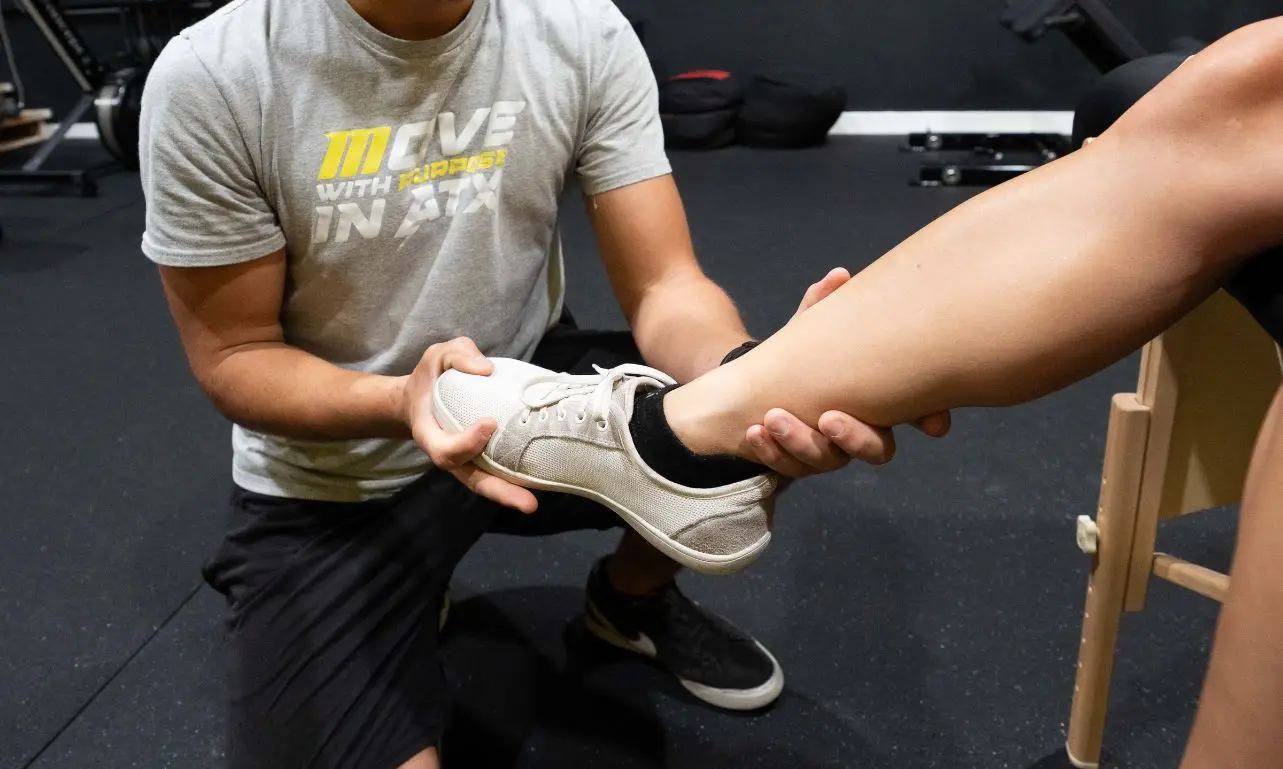
Search “functional range assessment near me” and you’ll get a mix of results. Some are legitimate FRA providers. A lot of them are gyms that took an FRC weekend course, liked the terminology, and now use CARs and PAILs/RAILs as a vocabulary without ever running the actual assessment behind it. I don’t say that to knock anyone starting out; everyone starts somewhere, and a weekend course is a real credential. But there’s a meaningful difference between a trainer who’s picked up some FRC exercises and a provider who can actually put numbers on how your joints move. If you’re searching for one, it’s worth knowing what you’re actually looking for before you book something.
What the FRA is actually measuring
The Functional Range Assessment is a joint-by-joint measurement system developed alongside Functional Range Conditioning by Dr. Andreo Spina. It measures two numbers at each joint: how far it moves passively, meaning with help, and how far you can move it actively, under your own control. The gap between those two numbers is where most of the useful information lives.
That gap matters because your nervous system, not your tissue, sets the outer limit of how far a joint is allowed to move under your own control. Stretch training can expand passive range fairly reliably; a well cited 2014 study found that three weeks of stretch training increased passive dorsiflexion range by nearly 20 percent, but the researchers traced that change to increased stretch tolerance and tissue elongation, not to any change in how the nervous system was driving the muscle (1). In plain terms, you can get more willing to be pushed into a range without ever gaining the ability to get there yourself. A joint that has a big active-to-passive gap is a joint the brain doesn’t fully trust yet, and that’s usually where compensation, stiffness, or a nagging ache shows up down the line.
The FRA exists to find those gaps before they turn into a bigger problem, and to give you an actual number instead of a guess.
What a real session looks like
A full FRA takes around two hours, and it isn’t a workout. You’re not there to sweat. Expect a joint-by-joint walkthrough, from the neck down to the toes, where each joint gets tested for passive range with a goniometer or similar tool, then tested again for how much of that range you can access and control on your own. Some joints also get isometric strength testing at specific points in that range, since strength at end range is a different quality than strength in the middle of it. Providers who are also FRC certified will often run you through Controlled Articular Rotations as part of the picture, watching not just how far you go but where the movement breaks down or gets compensated by a neighboring joint.
What you walk away with is a set of baseline numbers, a short list of the joints doing the most to hold you back, and a clear read on which priority matters most right now: mobility development, end-range strength, or plain motor control. A good provider turns that into a follow-up conversation about what actually happens next in your training, not just a printout.
What to check before you book with someone
Since the terminology gets borrowed loosely, a few direct questions will tell you fast if you’re talking to someone who runs the actual assessment.
Ask if they measure both passive and active range separately, joint by joint, or if they’re doing a general movement screen and calling it an FRA. Ask if you’ll get actual numbers you can track over time, not just a verbal impression of what felt tight. Ask if the provider is certified through Functional Anatomy Seminars, which is the only body that actually certifies FRA practitioners; FRC or KINSTRETCH certifications are related but not the same credential. And ask what happens after the assessment. If the answer is a generic program that looks the same for every client, the assessment wasn’t really driving anything.
None of this means you need to drive across town for the perfect provider. It means you’re allowed to ask a couple of questions before handing over two hours and a training budget.
Why start here instead of just training
Most people’s instinct when something feels off is to find the right exercise for it. The problem is that a stiff hip and a stiff hip aren’t the same stiff hip. One person’s hip is limited by a genuine lack of passive range, the tissue simply doesn’t have the room yet. Another person’s hip has plenty of passive range sitting there unused, because the active-to-passive gap is the actual issue, and no amount of stretching that hip is going to close a gap that stretching didn’t create.
Training off an assessment means you’re not guessing which of those two problems you’re solving. It also catches the joints you’d never think to check on your own; people show up expecting a shoulder issue and find out their thoracic spine has been quietly doing none of the work for years. That’s the value of going joint by joint instead of chasing symptoms.
Finding one in South Austin
If you’re local, this is exactly what we run at Motive Training in St. Elmo. We use the FRA as the starting point for most new clients, not because it’s required paperwork, but because it tells us where your training actually needs to go instead of guessing off a generic intake form. You can read more about how we structure it on our Functional Range Assessment page, or dig into the broader FRC system it sits inside of if you want the fuller picture before you come in. We also teach the daily maintenance side of this in our Controlled Articular Rotations guide, which is worth a look regardless of who ends up running your assessment.
If you’re ready to get your own numbers instead of guessing, you can schedule with us and we’ll walk you through it.
References
Written by

Brian Murray, FRA, FRSC
Founder of Motive Training
We’ll teach you how to move with purpose so you can lead a healthy, strong, and pain-free life. Our headquarters are in Austin, TX, but you can work with us online by signing up for KINSTRETCH Online or digging deep into one of our Motive Mobility Blueprints.