Every joint in your body has two numbers worth knowing. The first is how much range it can move through passively (with assistance, with gravity, with someone else moving the limb for you). The second is how much of that range you can actually control on your own, under load, with intent behind it. The gap between those two numbers is where most injuries happen. It is also where most training programs never look.
The Functional Range Assessment is built around that gap. It is a joint-by-joint measurement system developed by Dr. Andreo Spina as part of the Functional Range Systems family, the same framework that produced FRC and KINSTRETCH. The goal is to quantify what you have and what you can control, so the decisions about what to train next are obvious rather than speculative.
What the assessment actually measures
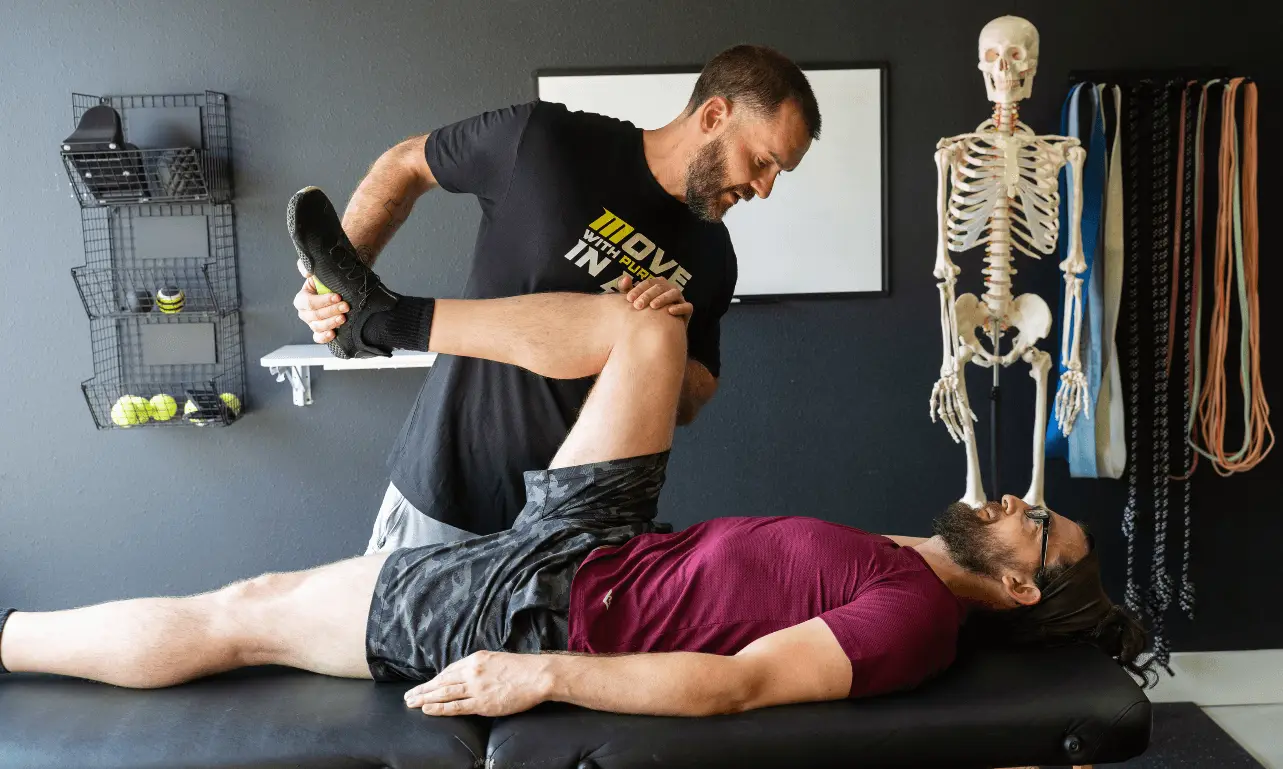
The FRA works through each major joint: spine, shoulders, hips, knees, ankles, wrists. At each joint, we measure passive range first (how far the joint can move when we move it) and then active range, how far you can move it yourself with muscular control. That active-passive gap is the data point that drives everything else.
A large gap at the hip tells us there is range available that the nervous system is not accessing or trusting. That is not a stretching problem in the conventional sense; it is a control problem. The tissue can get to a certain position, but the brain won’t let you get there on your own under any meaningful load. Stretching that hip more is not going to close that gap. Building neurological ownership of the range will, and those are different interventions.
A small gap but a restricted overall range tells us something else entirely: the joint needs capacity development before control work makes sense. There is not enough range to work with yet. You need to expand the ceiling before you can train within it.
A restricted range with almost no gap (passive and active are nearly equal, both limited) often points to a structural or capsular issue that needs to be respected in how we load the joint. We are not trying to force range; we are trying to work within what exists safely while supporting the tissues around it.
Three different findings, three different training responses. This is why measurement matters. Without it, you are applying the same intervention to all three and wondering why it is not working on two of them.
This is also what separates the FRA from a general movement screen. Most screens blend multiple joints into one task, which means a strong joint can mask a weak one and you leave without knowing what actually needs attention. If your shoulder mobility compensates for a thoracic restriction during an overhead squat, the screen sees a functional overhead squat. The FRA sees a restricted thoracic spine and a shoulder working harder than it should. Isolating each joint, standardizing the measurement, and recording the numbers means progress becomes visible rather than felt, and regressions get caught before they become injuries.
What an FRA appointment looks like at Motive
We start with a conversation, usually ten to fifteen minutes, about what you are dealing with and what you are training toward. Pain, performance, longevity; those priorities change which findings we focus on, so it matters before we start measuring. Someone who came out of a knee surgery and wants to return to trail running needs different emphasis than someone whose shoulder has been limiting their pressing for two years. The data is the same kind of data; what we do with it is shaped by where you are trying to go.
From there we move through a full-body CARs analysis. Controlled articular rotations at each joint give us a qualitative read on how the joint is moving before we get into formal testing. This is not a warm-up; it is information. We are watching for where range drops off, where compensation patterns appear, where you lose control at end range and the joint deviates or the surrounding segments take over. A hip CAR where the pelvis starts rotating to compensate for limited hip internal rotation tells us something immediately. So does a shoulder CAR where the scapula wings before the arm gets to ninety degrees.
The CARs analysis also does something most assessments skip: it gives you information about yourself in real time. A lot of clients have never tried to move a single joint through its full range in isolation. They discover things during this portion that have been there for years and gone unnoticed because no one ever looked at that joint specifically.
The table testing is where the formal measurement happens. This takes the bulk of the session, close to an hour. Each joint gets tested for passive range with standardized positioning and then for active range under the same conditions. We are measuring, recording, and comparing. The shoulder in external rotation with the arm at ninety degrees of abduction. Hip flexion, extension, internal and external rotation. Ankle dorsiflexion. Thoracic rotation. Every number goes into the record.
By the end of this portion, the picture is fairly complete. We know which joints have adequate range and adequate control, which have range but not control, which are globally restricted, and which need to be handled carefully. Most people have a mix. The findings are almost never evenly distributed across the body, which is part of why generic mobility programming underdelivers; it addresses everything at the same intensity rather than what actually needs it.
We close with a priorities conversation, usually fifteen to twenty minutes. This is where the data becomes a plan. You leave knowing which joints are the first-order priority, what kind of work is indicated for each (daily CARs, PAILs and RAILs for end-range loading, more aggressive capacity work, or conservative input given the state of the joint), and what the next training block should look like. The goal is that you are not confused about what to do next. The assessment should make the next step obvious.
The full appointment runs about two hours. That is not a long time given what it produces, but it is worth knowing before you book.
What changes in your training after an FRA
The most common thing we see after an FRA is that people stop training the joints that feel tight and start training the joints that are actually limited. Those are not always the same joints. The hip that feels tight is often compensating for a thoracic spine that cannot rotate. The shoulder that aches is often downstream of a shoulder blade that is not moving well. Training the complaint without understanding what is driving it is a reliable way to stay in the same place.
The assessment also changes the dose. Knowing that someone has a large active-passive gap at the hip in internal rotation means we know to prioritize PAILs and RAILs work there, and we know how to load it and how aggressively. Knowing that the ankle is globally restricted means CARs and progressive mobility work, not just end-range loading into a range that does not exist yet. The programming behind this kind of work has real structure to it; the FRA tells us where to apply it.
For clients who have been doing mobility work for a while, the assessment often reorients the effort. Not everything needs equal attention. The joint that has adequate range and adequate control can be maintained with less volume. The joint that is driving compensatory patterns elsewhere gets prioritized. That reorientation alone tends to produce faster change than doing more of everything.
How FRA connects to FRC and KINSTRETCH
The three systems are designed to work together. FRA is the measurement layer: it tells us what exists and what is missing. FRC is the training system that acts on those findings: Controlled Articular Rotations for daily joint maintenance and assessment, PAILs and RAILs for end-range strength development, and more advanced loading as capacity grows. KINSTRETCH is the group environment where that work gets practiced with coaching and structure, and where the principles of FRC become a consistent practice rather than something you do occasionally.
Without the assessment, FRC and KINSTRETCH are still useful. But the FRA makes the work more direct. Instead of training the joints that feel the tightest or the ones that everyone trains, you are training the joints that actually need it, in the way they actually need it. For someone who has been at this for years without the change they expected, that specificity is usually what was missing.
Who gets the most out of it
The people who tend to benefit most are the ones who have tried things and gotten partial results. Runners dealing with recurring knee or hip issues that stretching has not resolved. People who came out of physical therapy functional but not quite right, with a sense that something did not fully come back online. Athletes with stubborn performance ceilings they cannot explain. Anyone who has been told to work on their mobility, has worked on their mobility, and is still in the same place.
The FRA does not require any particular baseline. It meets you where you are. That said, it is a performance and movement capacity assessment, not a diagnosis. It does not treat anything medically. If we see something during the assessment that warrants a different kind of attention, we say so directly.
If you are ready to start with the full assessment, you can book a Functional Range Assessment directly. If you want a lower-commitment entry point first, the Motive Movement and Mobility Assessment is a good place to begin before stepping into the full FRA process.
Written by

Brian Murray, FRA, FRSC
Founder of Motive Training
We’ll teach you how to move with purpose so you can lead a healthy, strong, and pain-free life. Our headquarters are in Austin, TX, but you can work with us online by signing up for KINSTRETCH Online or digging deep into one of our Motive Mobility Blueprints.