Tennis is one of the more one-sided sports you can play. Every serve, every groundstroke, every overhead loads the same shoulder, the same side of the trunk, the same forearm, thousands of times a season. Play a couple times a week in a CATA league or just pickup sets at Caswell or Pharr and that repetition adds up fast, coached or not.
What the serve actually builds, and what it doesn’t
A good serve needs the shoulder to reach deep external rotation at the top of the motion, then reverse into internal rotation almost instantly as the racket comes through. Overhead and racket athletes are well documented for developing a glenohumeral internal rotation deficit, GIRD for short, on the dominant side: a measurable gap between how far that shoulder externally rotates and how far it can internally rotate back, relative to the other arm. Professional tennis players with a history of shoulder pain show significantly more of this rotation asymmetry than pain-free players (1). The serve trains one direction aggressively and does almost nothing for the other. Left unaddressed, that same asymmetry tends to show up one joint over in the shoulder blade itself, since scapular positioning has to compensate for whatever the glenohumeral joint can’t provide.
The thoracic spine carries more of the serve than most players realize. Thoracic extension at the top of the motion is what lets the shoulder reach overhead without pulling extra range out of the lower back, and a stiff mid-back on one rotational side, common given how one-sided tennis is, forces the shoulder to make up the difference. Players who feel stuck on serve day often have more restriction sitting in the mid-back than they realize.
Left alone, the shoulder and thoracic gap tends to show up as impingement symptoms during serves and overheads, or as compensation further down the arm. This isn’t just a coaching hunch. Clinical case series have identified lateral epicondylitis, tennis elbow, developing in players with an unrecognized loss of shoulder internal rotation on the same side, where the wrist ends up flexing further than it should during the serve to make up for range the shoulder couldn’t supply (2). That’s a big part of why tennis elbow shows up in players who never touch a one-handed backhand or anything else that looks like an obvious culprit.
The wrist sits at the end of that same chain and absorbs more than it gets credit for. Every stroke transmits grip force and impact load through it, and wrist flexion specifically tends to go unexamined until it’s already limiting a serve or a two-handed backhand. It’s a small joint doing disproportionate work, and in the compensation pattern described above, it’s often the joint being asked to supply motion that should have come from further up.
Match play exposes the range, it doesn’t train it
A few serves and some jogging before a match raises tissue temperature and rehearses your swing. It doesn’t teach the shoulder’s internal rotators, or the thoracic spine’s weaker rotation direction, anything about strength at end range, because nothing about hitting more serves asks those tissues to work in isolation.
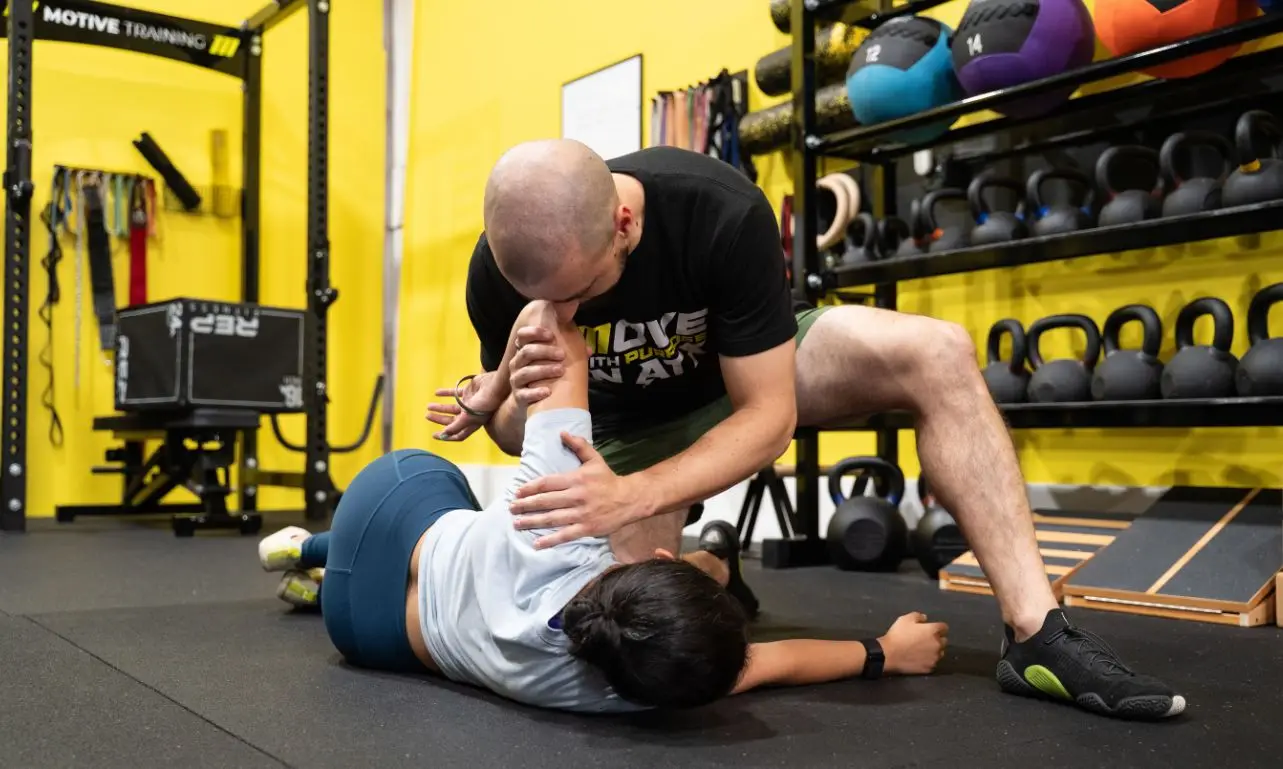
Controlled Articular Rotations and end-range isometric loading close that gap directly, built at the exact ranges a serve demands rather than the ranges match play happens to expose. Reading what a joint is telling you during that work matters too. A shoulder that pinches at a specific point in a CAR is giving you real information, and learning to read those signals rather than pushing through them is part of training smart instead of just training hard.
None of this means playing less tennis. It means the players who stay ahead of shoulder and elbow trouble tend to be the ones training the ranges tennis never asks them to train on its own, rather than hoping more court time somehow evens things out. If a shoulder or elbow is already bothering you, a functional mobility assessment is the place to find out what’s actually restricted before you guess.
References
- Moreno-Pérez V, Moreside J, Barbado D, Vera-Garcia FJ. Comparison of shoulder rotation range of motion in professional tennis players with and without history of shoulder pain. Manual Therapy, 2015
- Occult periarthrosis of the shoulder: a possible progenitor of tennis elbow
Written by

Brian Murray, FRA, FRSC
Founder of Motive Training
We’ll teach you how to move with purpose so you can lead a healthy, strong, and pain-free life. Our headquarters are in Austin, TX, but you can work with us online by signing up for KINSTRETCH Online or digging deep into one of our Motive Mobility Blueprints.