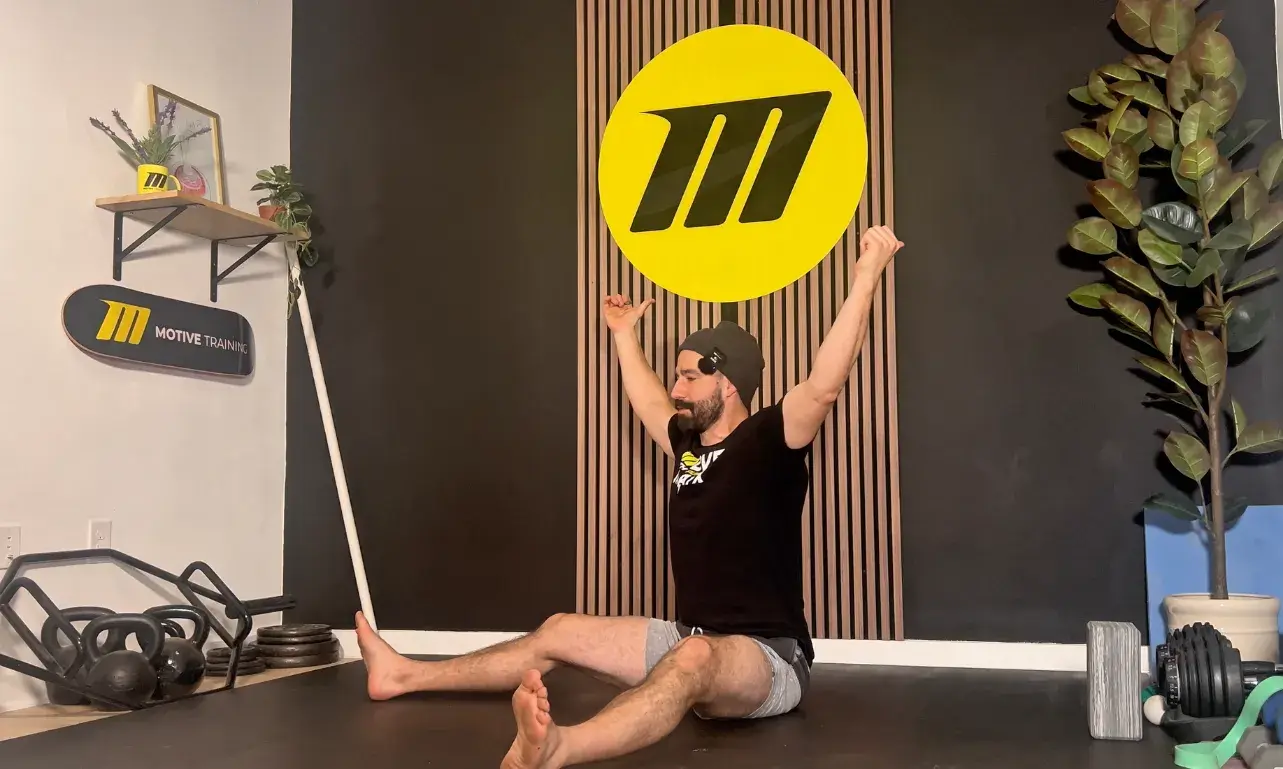
The conversation about posture almost always starts at the wrong joint. Someone rounds forward at the shoulders, their head drifts in front of their body, their low back aches by the end of the day, and the fix gets aimed at the symptoms. Pull the shoulders back. Tuck the chin. Brace the core. None of it lasts, because the actual driver is usually a floor above the place that hurts. The thoracic spine, the part of your back behind your ribs, has lost the ability to extend, and every joint around it is paying the bill.
That’s the principle worth understanding before any of the drills make sense. So let’s start there, because the depth of the problem is the whole reason a single stretch doesn’t solve it.
The t-spine is supposed to round. The problem is when it gets stuck
The thoracic spine is built for flexion. Twelve vertebrae, each one with a pair of ribs attached at two separate joints, sitting in a natural forward curve called kyphosis. That curve isn’t a flaw. It’s structural. It gives the rib cage its shape, protects the heart and lungs, and lets you round forward to absorb impact, brace, reach across your body, curl into a ball. Flexion isn’t the issue. The issue is when you live there.
Sit at a desk for eight hours, hunch over a phone for another three, sleep curled on your side for another six or seven, and the t-spine stops being a joint that can move in both directions and becomes a joint that mostly does one thing. The extension side of its range goes missing because nothing in a normal day asks for it. The body adapts to where you spend your time, which is a feature, not a bug. It’s just inconvenient when the position you spend your time in is also the position that compromises everything else you’d want to do.
The piece most posture content gets wrong is treating this as a muscle problem. It isn’t, or it isn’t only. The mechanical restriction in a stuck t-spine lives across several tissues at once, which is most of why one drill doesn’t fix it.
What actually gets stuck
The rib attachments are the part nobody talks about. Each thoracic vertebra has a rib joining it at two places, the costovertebral joint on the side of the vertebral body and the costotransverse joint at the transverse process. So every segment of your thoracic spine has six rib articulations around it that all need to move when the spine moves. When those joints lose mobility, and they do, because nothing in eight hours of sitting asks for the ribs to flare or expand at the back, the spine segment they’re attached to can’t extend properly. The motion is mechanically blocked at the rib joint before the spine joint even gets a chance to move.
The deep paraspinal muscles, the small ones that run between each vertebra, get short and weak at the same time. Multifidus and rotatores live in extension. They’re meant to produce small, segmental extension motions, the kind that let one vertebra extend at a time. When you sit flexed for years they shorten in a flexed position, lose the strength they had at end-range extension, and stop firing well enough to organize a clean rib-by-rib extension when you do try.
And then there’s the front of the body, which is the part of the t-spine problem that nobody addresses. The abdominal wall, particularly the upper abs and the connective tissue running from the rib cage to the pelvis, locks into the flexed position from years of sitting. You can’t extend the spine if the tissue on the front of it won’t lengthen. This is the abdominal release piece of the Posture Problem class, and it’s the step most foam-roller-only routines skip, which is why those routines don’t hold. Open the back without releasing the front and the front pulls everything closed again within hours.
So the restriction is multi-tissue. Rib joints, deep spinal musculature, abdominal wall, fascia. A single drill addresses one of those at a time. That’s why the work has to be sequenced, not just attempted.
The bill everything else pays
The reason this matters more than any other posture issue is that the t-spine doesn’t fail in isolation. It fails and exports the problem to its neighbors, and the neighbors take real damage over time.
The low back is the first to absorb it. Watch someone with a stiff t-spine try to reach overhead and the lumbar spine arches dramatically to compensate. Same with anyone trying to stand up straight without enough thoracic mobility. They look like they’re standing tall, but they’re really just hyperextending the low back to fake the shape. The low back hates that for reasons that are mechanical, not mysterious. The lumbar spine has small facet joints oriented for flexion and rotation, not repeated heavy extension. The thoracic spine is built for the load. Sending extension demand to the wrong floor of the building is most of why people who “have bad posture” end up with low back pain, and why fixing the low back directly usually doesn’t fix anything. The low back isn’t the cause. It’s the compensation. We’ve made this case in a different shape before, that your back pain isn’t always a back problem, and t-spine extension is one of the cleanest examples.
The shoulder pays a different version of the same bill. Getting your arms fully overhead requires the t-spine to extend. The shoulder blade has to tilt back and the rib cage has to lift to give the arm bone the room it needs. If the t-spine won’t extend, the scapula has to tilt forward instead to make room, which compresses the space the rotator cuff tendons pass through. That’s a mechanical setup for impingement, and it’s why so many shoulder issues in desk workers don’t resolve until the thoracic spine starts moving. The shoulder isn’t broken. The platform underneath it is locked in a position the shoulder can’t work around.
The neck gets the most visible version. Forward head posture, the chin-jutting-out look almost everyone has now, sits on top of a kyphotic thoracic spine. You can chin-tuck and stretch your neck for the rest of your life and the head will keep drifting forward, because the head has to stay over a base, and if the base is tilted forward at the t-spine, the head follows. We’ve written about the cervical problem on its own, but the t-spine is usually the foundation underneath it.
And then there’s breathing, which is the consequence that almost nobody connects to posture but ends up affecting how someone feels all day. The diaphragm sits at the bottom of the rib cage and does most of its work by pulling the lower ribs out to the sides and down as you inhale. That rib motion requires the thoracic spine to be mobile enough to let the ribs move. A locked t-spine restricts rib expansion, which forces a shallower, more upper-chest-driven breath. People with stuck thoracic spines tend to breathe with their neck and accessory muscles, which feeds back into the neck and shoulder tension already in motion. The whole pattern reinforces itself.
That’s the cost of a stuck t-spine. Low back compensation, shoulder impingement risk, forward head posture, restricted breathing. Each of those is a separate problem people try to fix on its own, and each of them has the same upstream driver.
How to know if this is you
You don’t need an assessment to get a useful read on your own t-spine. A couple of simple checks tell you most of what you need to know.
Stand with your heels, hips, and shoulders against a wall, then try to get the back of your head to the wall without lifting your chin. If your chin has to come up to make contact, or your head can’t reach the wall at all without it, you’re looking at a thoracic extension limitation. A spine that can extend will let the head sit level over the body without compensation. A spine that can’t makes you choose between getting your head back or keeping your chin down.
Or try this one on the floor. Lie on your back with your knees bent and your feet flat. Press your low back into the floor so there’s no gap between your spine and the ground, and hold that. Now reach your arms overhead and try to touch the backs of your hands to the floor above your head without letting the ribs flare or the low back lift. Most people can’t do it. The arms get most of the way and then either the ribs pop forward or the back arches off the ground to let the arms finish the motion. Both of those are the t-spine refusing to extend and the body finding another way.
The last one is the most diagnostic for sitting-related restriction. Sit up tall in a chair without leaning against the backrest, and try to look straight up at the ceiling. If you can only get there by arching your low back or jutting your chin up, your t-spine isn’t doing the work. The extension is supposed to come from the upper back. If it comes from anywhere else, you’ve got the same compensation pattern that everything in this article has been about.
Two out of three of those, and the t-spine is almost certainly your limiter. All three, and it’s not a question.
Opening the range is the easy part. Owning it is where the work happens
Most posture content stops at “stretch your t-spine.” Drape over a foam roller, sigh deeply, feel something pop, repeat tomorrow. That gets you a temporary opening of the range, which is fine as far as it goes. The catch is that the body protectively limits ranges it doesn’t trust you to control, and lying on a roller doesn’t teach control. It teaches receiving. So the range you opened in the morning is gone by lunch, because nothing taught the nervous system that extending the t-spine on your own is safe and doable.
That’s the missing half of nearly every posture routine on the internet. You need to open the range, and then you need to actively contract into it under your own muscle, which is what tells the nervous system the new position is yours. The same logic runs through every joint we train, and it’s why flexibility and usable mobility aren’t the same thing. Range without strength to back it up doesn’t stay.
Andres put together a short video that demonstrates this in three moves, all pulled from the first class in our Posture Problem series in KINSTRETCH Online. It’s worth watching, because the difference between opening the range and owning it is more obvious to see than to describe.
The pattern in those three moves is what makes them work as a unit rather than just stretches. The first creates the space, the next two ask you to produce force inside it. The order matters, the contraction matters, and the part nobody sees on Instagram is the layer underneath, the abdominal release, the t-spine CARs, the segmental work that gets the thoracic spine moving piece by piece before you ever load extension. The video is a window into the principle. The class is where the work actually happens.
What this means for what you should do
If your back, neck, shoulders, or breathing are bothering you and you keep going after the spots that hurt, the move worth trying is one floor up. Spending consistent time getting the thoracic spine to extend, and then teaching it to extend under your own power, is probably the highest-leverage change you can make for posture and for the cascade of issues that ride along with it. The t-spine sits underneath all of it.
There’s a way to do this on your own with a roller and good intentions, and we’ve seen it work for a few people. More commonly we see the pattern from earlier. The range opens, the range closes again, nothing changes structurally, and the compensation pattern keeps doing its damage. The version that holds up is when you also train extension under load, and that takes a sequence, the right cues, and someone watching whether your low back is creeping in to cheat. That’s the work the Posture Problem series in KINSTRETCH Online is built around, and it’s why we built it as a series rather than a one-off video. T-spine extension isn’t a stretch you do once. It’s a range you reclaim over weeks, and then maintain.
If you’re not sure whether the t-spine is the right starting point for your specific situation, the movement assessment tells us, and from there you’d know whether to start with the Posture Problem track or somewhere else. The point isn’t that t-spine extension is the answer to everything. The point is that it’s the answer to a lot more than people think.
Written by

Brian Murray, FRA, FRSC
Founder of Motive Training
We’ll teach you how to move with purpose so you can lead a healthy, strong, and pain-free life. Our headquarters are in Austin, TX, but you can work with us online by signing up for KINSTRETCH Online or digging deep into one of our Motive Mobility Blueprints.