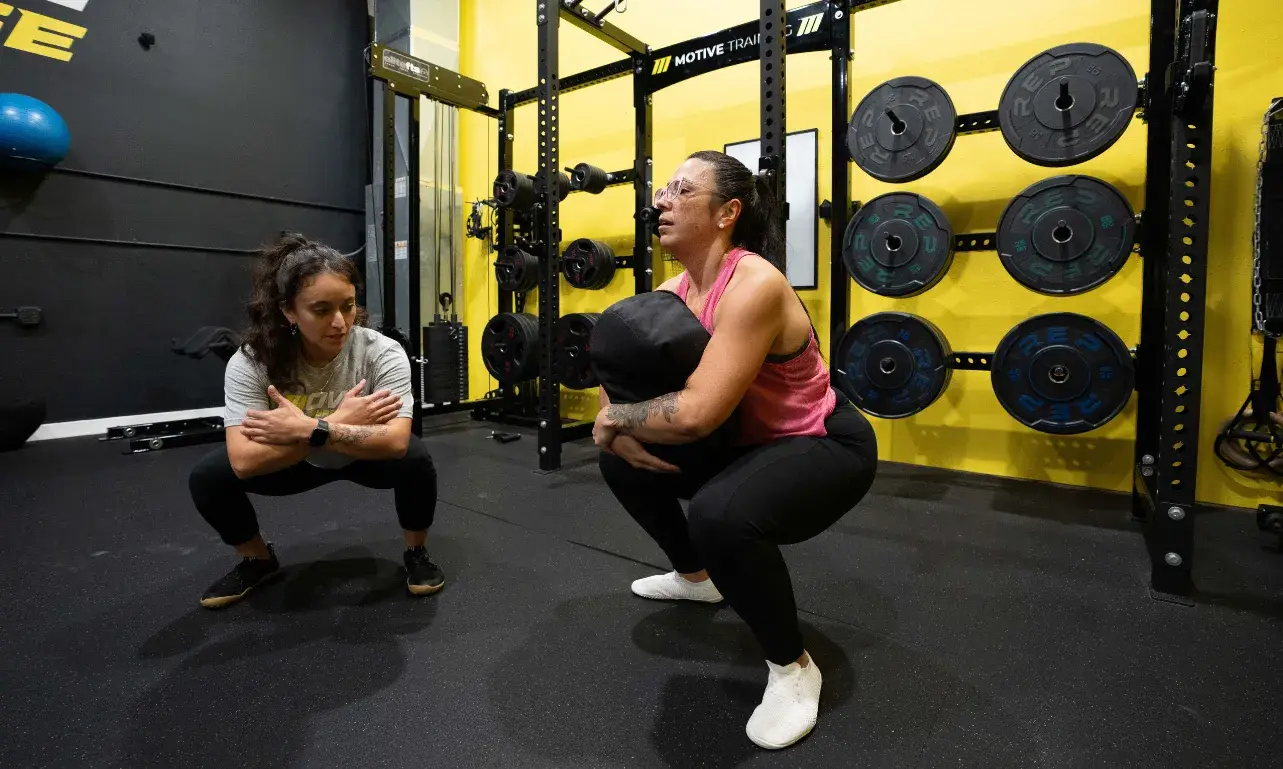
A significant portion of the women who train at Motive have trained somewhere else before. Different places, different experiences, but a few patterns show up consistently. The program was generic. The assessment, if there was one, was surface-level. The training didn’t connect to how they actually moved or what their body specifically needed. And at some point, progress stalled or something started hurting, and there wasn’t a framework for understanding why or what to do about it.
That’s not an indictment of every other gym in Austin. Some trainers do this work well. But it describes a real gap in how personal training gets delivered, and it’s worth being specific about what a different approach looks like and why it matters.
What Assessment-Based Training Actually Means
The term gets used loosely, so it’s worth defining. At Motive, every new client goes through a movement assessment before any programming decisions get made. Not a fitness test, not a body composition measurement, not a conversation about goals and then straight to the squat rack. An actual evaluation of how the joints are moving, where the restrictions are, what the compensation patterns look like, and what the body needs before it gets loaded.
The Functional Range Assessment we use is a joint-by-joint evaluation developed within the FRC system. It looks at each joint’s active range of motion, strength at end range, and how the body compensates when range is limited. The output is specific: not “your hips are tight” but rather which direction, by how much, and what the consequences are downstream in the kinetic chain.
That specificity matters because two people with the same goal, the same age, and the same training history can have completely different needs. A program built around one doesn’t serve the other particularly well. And for women specifically, there are a few recurring patterns that generic programming tends to either miss or work around rather than address directly.
The Hip-Knee-Core Connection
One of the most consistent patterns in women who train is the relationship between hip mobility, hip strength, and knee tracking. The combination of wider Q-angle (the angle from the hip to the knee, which tends to be greater in women due to pelvic anatomy) and reduced hip external rotator strength means the knee often tracks medially under load. That pattern is manageable at low loads; under heavy squats or high-rep lunges, it accumulates stress at the knee and lower back over time.
The solution is not to avoid loading. The solution is to build the hip capacity that allows the knee to track correctly under load, and that requires both mobility work (earning the hip external rotation range) and targeted strength work at the ranges that actually matter for the movements being trained.
This is one place where the mobility-first approach at Motive is different from a standard personal training program. We’re not just loading patterns and hoping the body adapts; we’re building the specific capacity the pattern requires before we ask the body to produce force through it. For a lot of women who’ve dealt with nagging knee or hip pain from training, this is the piece that was missing.
Strength Training and What It Actually Does
There’s still a version of the conversation in Austin gyms where women ask about strength training and get steered toward lighter weights and more repetitions. I understand where that comes from, and I think it’s largely wrong; we’ve made the full case for why women need to lift weights before, and the argument has only gotten stronger.
Strength training with progressive load is one of the most well-supported interventions for long-term health across the board: bone density, metabolic health, injury resilience, functional capacity as you age. The research on this is not ambiguous (1). The reason to train women differently from men in a strength program isn’t because women should avoid heavy loading; it’s because the specific mobility and stability patterns that need to be in place to load safely can differ, and those need to be accounted for in program design.
Women in their 40s and 50s are a population where this work is particularly well-invested. The rate of muscle loss and bone density reduction that accelerates in perimenopause and after menopause is meaningfully influenced by strength training (2), and jump training adds a bone density stimulus that lifting alone doesn’t fully provide. Not symbolically influenced; mechanically and hormonally influenced in ways that matter for quality of life decades out. A training program that addresses this population specifically, with attention to load progression and the mobility foundation to support it, is a different thing from a generic fitness class.
What a Session at Motive Actually Looks Like
Most sessions are one-on-one for 60 minutes. The structure isn’t rigid, because the program is built around what each person needs, but there’s a consistent approach: mobility work first (usually CARs and targeted end-range training for the joints we’re focusing on), then movement skill and pattern work, then strength loading, then cool-down and soft tissue if relevant.
The mobility component isn’t tacked on as a warm-up. It’s training. The joints we’re working through CARs and PAILs/RAILs are being assessed and trained simultaneously, and those ranges directly inform the strength work that follows. If hip external rotation is what we’re building, the strength session is going to load hip external rotation patterns. The two halves of the session connect.
Coaching is also specific. Not “good, keep going” but a real-time read on what the body is doing and why, with adjustments to position, load, and cuing based on what’s showing up. Seventeen years of this work means I’ve seen most patterns enough times to recognize them quickly and address them without wasting a session figuring out what’s happening.
Sessions are at our studio at 714 Shelby Lane in the St. Elmo neighborhood of South Austin. It’s a small, private space, which is intentional. One trainer, one client, focused work. No waiting for equipment, no background noise, no self-consciousness about what you’re working through.
Getting Started
The starting point for most new clients is the assessment. That gives us the information we need to build a program that’s actually calibrated to your body, not a template. The assessment takes about an hour, and by the end of it you’ll have a clear picture of where your movement is strong, where the gaps are, and what the priority work looks like.
If you’re not sure the assessment is the right first step, scheduling a consult is a good option. That’s a conversation about where you are, what you’re trying to accomplish, and what the path forward looks like. No pressure in either direction; it’s just information.
And if you’ve been through physical therapy or are coming back from an injury and trying to figure out what comes next, this piece on training after physical therapy covers that transition specifically. A lot of women are in that gap between “cleared by PT” and “back to training confidently,” and the bridge work there is something we do well.
The training is specific to you or it isn’t training. That’s the standard we hold at Motive, and it’s why the work tends to produce results that carry.
References
- Westcott WL. (2012). “Resistance training is medicine: effects of strength training on health.” Current Sports Medicine Reports.
- Daly RM, Dalla Via J, Duckham RL, Fraser SF, Helge EW. (2019). “Exercise for the prevention of osteoporosis in postmenopausal women: an evidence-based guide to the optimal prescription.” Brazilian Journal of Physical Therapy.
Written by

Brian Murray, FRA, FRSC
Founder of Motive Training
We’ll teach you how to move with purpose so you can lead a healthy, strong, and pain-free life. Our headquarters are in Austin, TX, but you can work with us online by signing up for KINSTRETCH Online or digging deep into one of our Motive Mobility Blueprints.